

Artemis Warrior Guide: How to Optimize Your Series A Fundraise
April 30, 2025

By The Artemis Fund
The Artemis Fund believes technology can create prosperity for all. With offices in New York, Texas, Massachusetts, and Nevada, Artemis leads seed rounds for companies creating resilient families, individuals, and businesses across the US.
For most founders, raising capital isn’t the dream — it’s solving a problem and creating life changing outcomes for themselves and their team. But it doesn’t have to be a nightmare.
At Artemis, we’ve seen that founders who run fundraising like a sales process — targeting the right investors early and building long-term relationships — consistently raise faster, with better terms, and stronger partners.
Get The Artemis Fund’s stories in your inbox.
Get The Artemis Fund’s stories in your inbox.
Sign up for our newsletter
Step 1: Know Your Customer — Series A Investors
Step 1: Know Your Customer — Series A Investors
Before deciding if Series A is right for you, understand how Series A firms think. A typical $100M fund makes just 2–3 investments per year, writing $5–10M checks for 20–30% ownership and a board seat. Their job is to back companies that can return 10–100x in 5–7 years. If you can clearly articulate your path to that kind of growth and exit, you’re aligned.
Step 2: Match Vision With Traction
Step 2: Match Vision With Traction
Venture capital has tightened. Liquidity is down. Expectations are up.
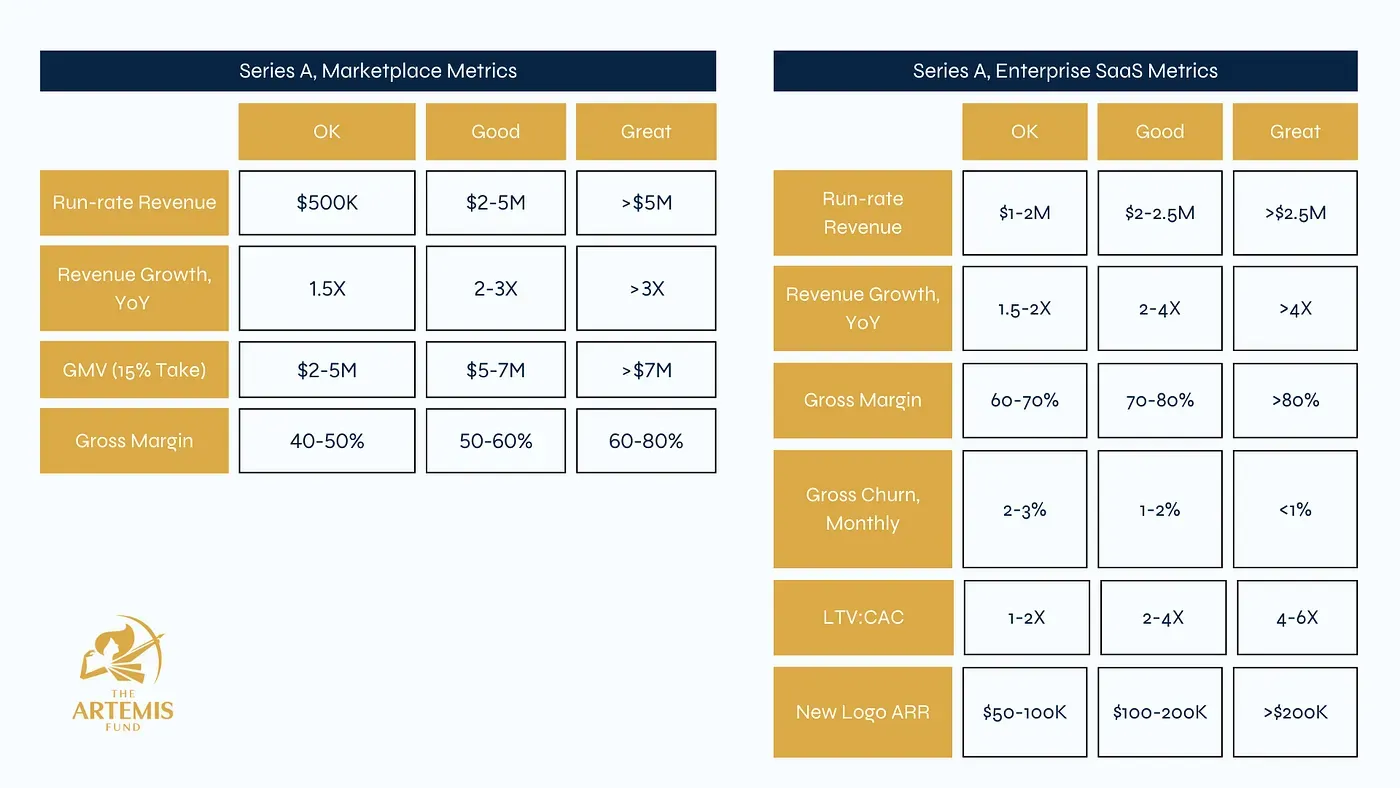
Series A investors now want more traction before committing. At Artemis, we’re seeing successful Series A raises when companies:
- Are approaching or surpassing $2–4M in ARR
- Show consistent year-over-year growth
- Have a clear path to $10M+ ARR
Step 3: Start Early, Build Your Funnel
Step 3: Start Early, Build Your Funnel
12–18 months before your raise:
Start planning for Series A as soon as you close your Seed. Build your pipeline with the same discipline you use for sales.
Create a target list of 20+ Series A firms that:
- Invest in your industry
- Recently raised a fund
- Have a portfolio that complements yours
- Ask for warm intros from your Seed investors and founder friends
Qualify your leads with intro calls:
- What check size do they write?
- What metrics do they look for?
- What did their last investment look like?
- What would they need to see from you in 12 months?
If you nail down 5–10 qualified, high probability targets, you’re on track.
Maintain momentum:
- Build the relationship — check in regularly and ask for customer or operator intros, seek advice, and demonstrate execution.
- Keep non-lead prospects warm with monthly or quarterly updates on traction and asks.
Step 4: Six Months Out — Get in the Zone
Step 4: Six Months Out — Get in the Zone
Now it’s game time. Build your materials and prepare to run a tight, efficient process.
Data Room Essentials:
- Overview: Deck, welcome note, roadmap to data room
- Financials: Historical + projected financials, balance sheet
- Market: Research that shows TAM, trends, and dynamics
- Legal: Articles, bylaws, cap table, past financing docs
- Team: Current org chart + hiring plan
- Customer: Pipeline, agreements, testimonials, Q&As, or even video clips
💡 Hot tip: Investors will want to speak to your customers. Pre-recorded materials protect their time and build investor confidence.
Step 5: Run the Process Like a Funnel
Step 5: Run the Process Like a Funnel
- Use your investor pipeline as your CRM
- Share it with your early investors to add feedback and contacts
- Schedule regular check-ins to track progress and stay aligned
- Pitch your top targets first — those you’ve built relationships with
- Understand their diligence process, timelines, and decision-makers
- Drive toward “No” or “Yes” — don’t get stuck in “Maybe”
- Follow up weekly; if you haven’t heard back in 2–3 weeks, move on
Set a clear deadline for term sheets and closing. Momentum matters.
Landing a strong lead makes everything else easier — pro rata investors follow, and co-leads often emerge.
Bottom Line:
A successful Series A doesn’t start with a pitch deck, it starts with a plan. Be intentional at every step: target the right investors, build relationships early, and run your raise with focus and discipline.
👉 Up next in Part Two: Navigating term sheets, negotiating key terms, and closing with confidence.
We believe once in a generation companies will be built by unexpected founders. If that sounds like you, pitch us here!

Newsletter Signup
