

Artemis Warrior Guide: Pricing Strategy for B2B Startups
September 29, 2026

By The Artemis Fund
The Artemis Fund believes technology can create prosperity for all. With offices in New York, Texas, Massachusetts, and Nevada, Artemis leads seed rounds for companies creating resilient families, individuals, and businesses across the US.
Pricing signals the relationship you're building with a customer and the value your product delivers. Getting it right early is critical, and because your business, market, and customers keep changing, pricing also benefits from regular revisiting instead of being set and forgotten. To help navigate the challenges that come with that, we sat down with two experts:
- Simon Ooley, Co-founder and CEO of Veles, an agentic CPQ (Configure, Price, Quote) software platform built for enterprise sales teams
- Saagar Mehta, a partner at Northlane, a boutique pricing consultancy that works with venture-backed software companies
This guide walks through how to choose a pricing model, package it, hold the line on discounting, and know when it's time to revisit the number altogether.
The Fundamentals
The Fundamentals
Pricing starts with understanding your value metric, which is a unit of measurement that determines how a customer is charged for a product (i.e. seats, tokens, etc) Our experts recommend deciding the value metric before any dollar figure gets attached to it. Six common value metrics include:
- Seats (per-user pricing) charges for each person who has access to the product. It fits products where value scales with team size.
- Transactions pricing charges per discrete event the customer completes through the product. It works well when the product sits directly inside a payment transaction.
- Outcomes pricing charges based on a measurable result the product delivers. It's the hardest of the six to implement well, since it requires measuring and attributing the outcome cleanly.
- Feature-based pricing sells specific capabilities individually instead of bundling them into a single price, so a customer pays only for the functionality they actually use.
- Usage or consumption pricing charges based on actual activity (i.e., API calls, data processed, tokens consumed. It fits products where value scales with volume rather than headcount. For AI products specifically, this often shows up as a pre-purchased credit or token pool that customers draw down as they use the product, rather than metered billing charged in arrears.
- Hot Tip: Many AI products run on free or discounted compute credits early on, often through an accelerator, cloud program, or a VC's startup perks. That subsidy can make a product's cost structure look healthier than it actually is. If price is set against subsidized token costs rather than the price you'll eventually pay in the open market, a rise in that cost, or simply the credits expiring, can turn a healthy margin into a loss overnight. Be sure to price against your real, unsubsidized cost from the start (even while the subsidy lasts), so a future increase in your actual costs doesn't force a price hike your customers never saw coming.
A good value metric grows naturally as the customer gets more value, is easy for buyers to understand and predict, is measurable, and doesn't punish a customer for using the product more.
Choosing Your Value Metric
Choosing Your Value Metric
After you’ve chosen your value metric, "how much do I charge?" is one of the hardest questions to answer.
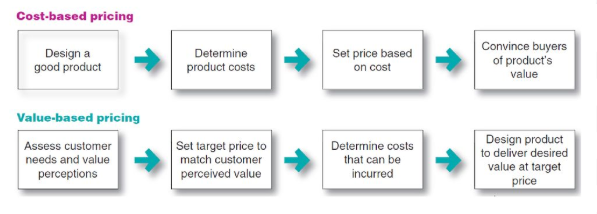
Cost-plus pricing starts from your own expenses and adds a margin on top. Say it costs you $2 a month in infrastructure and support to serve one seat. Price that seat at $10 a month and you're working off a 5x markup. The appeal is that it's simple to calculate and protects your downside. The weakness is that it has nothing to do with what the customer actually gains from using your product, so you could be leaving significant money on the table, or pricing yourself out of a deal a customer would gladly have paid more for. Cost-plus sets your floor: the minimum you can charge and still make sense as a business.
Value-based pricing starts from the other direction. Instead of asking what it costs you to deliver something, you ask what it's worth to the customer, and price as a share of that. The standard method for doing this is EVC (Economic Value to Customer) a classic B2B pricing framework built around the core idea that price is relative to what the customer would otherwise do. That "otherwise" option, their next-best alternative, might be a competitor's product, an internal workaround, a legacy tool, or simply doing nothing. Your price equals the price of that next-best alternative, plus a share of whatever additional value you create beyond it. Value based sets your ceiling: the most a customer would rationally pay given what they're getting. Most pricing decisions live somewhere between the two.
Here's what that looks like in practice. Say a customer is paying $20,000 a year for their current solution. Your product doesn't just replace that spend, it saves them an additional $10,000 a year in reduced errors or wasted time. That $10,000 is the value you've created beyond their next-best alternative. If you price to capture around 30% of that differentiation, you'd land around $23,000: the $20,000 they were already spending, plus $3,000 of the value you added. The customer still walks away with $7,000 of net benefit they didn't have before, and you've priced well above cost-plus without asking them to pay for anything abstract. They can see exactly where the number came from.
How the Value Metric Evolves as You Build
How the Value Metric Evolves as You Build
The value metric that makes sense on day one rarely stays the right one forever, and that's a normal part of growing. Early on, with one product and a narrow use case, a simple metric like seats or a flat fee is usually correct: it's easy to sell, easy to explain, and you don't yet have the usage data to price more precisely. Tomasz Tunguz has pointed to the $10M to $50M ARR range as roughly when this typically shifts, once companies have launched additional products that could stand alone and are trying to grow both the size of each account and their addressable market.
The pattern across companies that have made this transition well is consistency: they don't reinvent the value metric with every new product, they extend the one they already have. Atlassian kept "users" as its primary value metric across Jira, Confluence, and Trello, so a customer already understands how a new product will be priced before they've even looked at it. HubSpot did something similar, pricing its marketing, sales, and service hubs on a consistent structure of contacts, users, and tier, so growth in any one hub is intuitive to a customer who already understands another. Salesforce and Intercom both evolved further, layering in editions, add-ons, and multiple metrics as their products matured, moving from a single simple number toward something that captures more of the value across a larger product line.
Ultimately, it's worth thinking now about which of your metrics could extend cleanly to a second or third product later, even with only one product today. A metric tied tightly to one specific feature will force a harder reset down the line than one built around a broader unit of value a second product can plausibly share.
Pricing Models
Pricing Models
Each model fits a different stage and buyer.
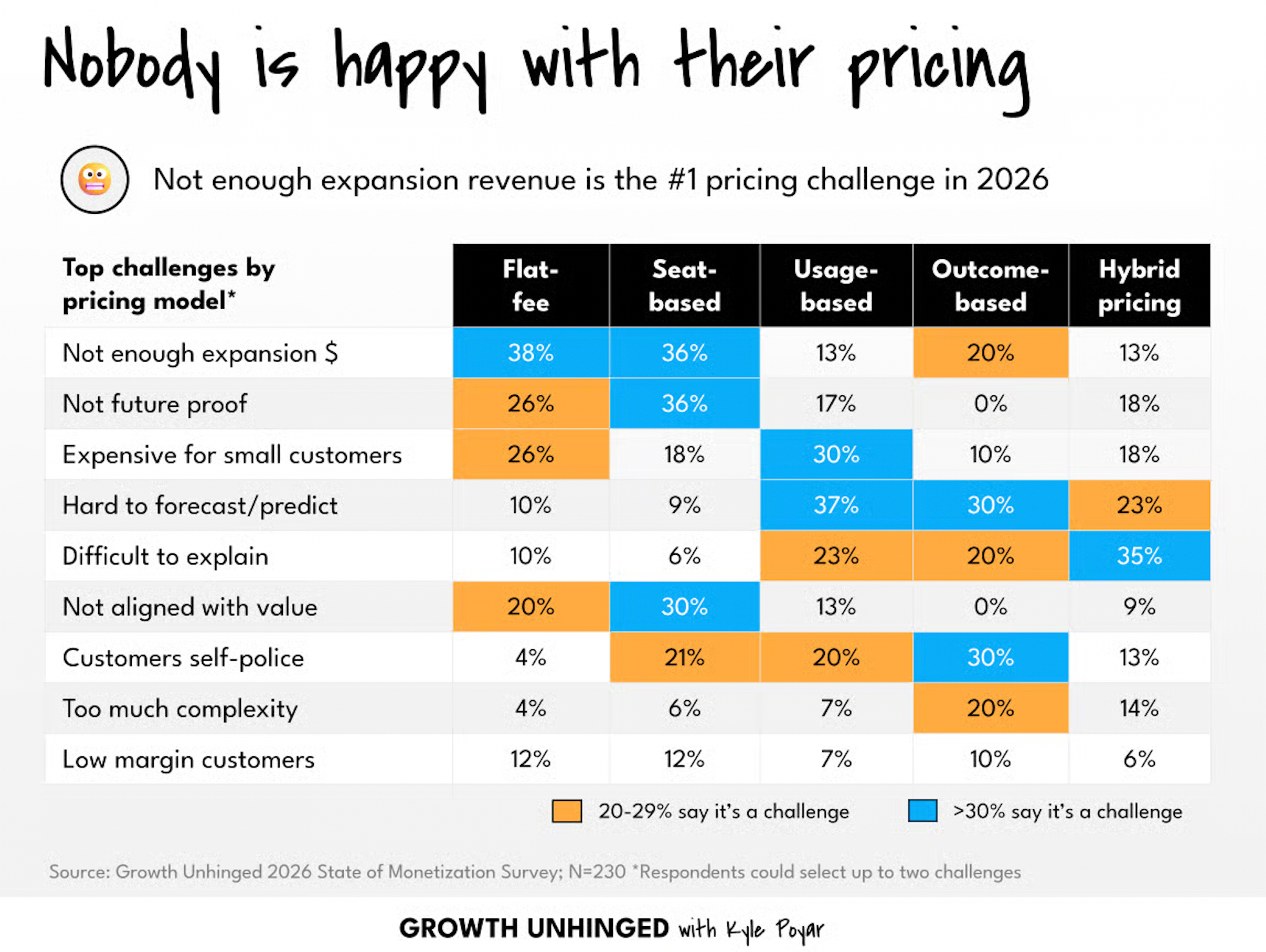
- Flat fee charges one price for full access, with no usage tracking required. It's the simplest model to sell, and needs no billing infrastructure beyond a standard subscription.
- Tiered pricing packages the product into multiple price points, usually differentiated by feature access or usage limits. It gives you a self-serve upgrade path and lets you sell to a wide range of buyer sizes without custom pricing for every deal.
- Usage-based pricing charges according to actual consumption (API calls, transactions, data processed, etc). It aligns price directly with value delivered and captures more revenue automatically as a customer's usage grows, without you having to renegotiate anything.
- Hybrid pricing combines a base fee with a usage or seat component on top, most commonly a flat platform fee plus overage billing. It gives you predictable base revenue while still capturing expansion upside from your heaviest users.
When should you reevaluate your pricing model? These indicators are helpful flags to review your model:
- Customer expansion is happening in actual usage, but it isn't showing up in invoiced revenue
- Sales reps are negotiating custom terms around the published price instead of within it
- Renewals increasingly need one-off carve-outs the original contract can't accommodate.
If your highest-usage, most engaged customers are paying proportionally less than customers who barely touch the product, the value metric has become misaligned. When a company does decide to shift pricing, departments can drift out of alignment. Sales will still chase the largest possible deal, product wants a smaller land that expands over time, and marketing is still targeting the profile that matched the old model.
If you raise prices, grandfather existing customers into their current rate for a defined window rather than indefinitely, to avoid alienating them. A stated period (i.e., 30 to 90 days for smaller accounts, and longer for enterprise), avoids creating a permanent shadow-pricing tier.
How you communicate the change matters as much as the change itself: lead with the value you've added since the customer signed up, not with the cost pressures behind the decision. Give real advance notice rather than surprising someone on an invoice, and for your largest accounts, a direct conversation before the announcement is strongly encouraged.
Packaging
Packaging
Good-better-best tiers are standard pricing packaging because they can capture a wide range of buyer sizes, reducing custom deal negotiation. Your middle tier should be the workhorse, the plan most customers land on by default. The bottom tier serves price-sensitive or smaller buyers, and the top tier serves larger accounts with more complex needs.
Each tier should answer a distinct customer's job-to-be-done in one sentence. If you can't distill it down to one sentence, the packaging isn't finished yet. When you know which segment each tier is built for, you should explore how you actually control what that segment gets, also known as gating.
- Feature-gating restricts entire capabilities to higher tiers, reserved for what only larger or more sophisticated buyers need, things like SSO, audit logs, or advanced permissions.
- Usage-gating caps how much of the product a tier can consume, like number of seats, volume of API calls, or storage limit, rather than blocking a feature outright.
- Support-gating changes the level of service that comes with a tier, faster response times, a dedicated account manager, or onboarding help, without touching the product itself.
Gating something a customer needs to prove your product's core value creates resentment. The discipline is in reserving gates for genuinely advanced needs. The upgrade trigger between tiers should feel like a natural milestone the customer hits as they grow, not a wall they run into unexpectedly.
Mastering the Enterprise Motion
Mastering the Enterprise Motion
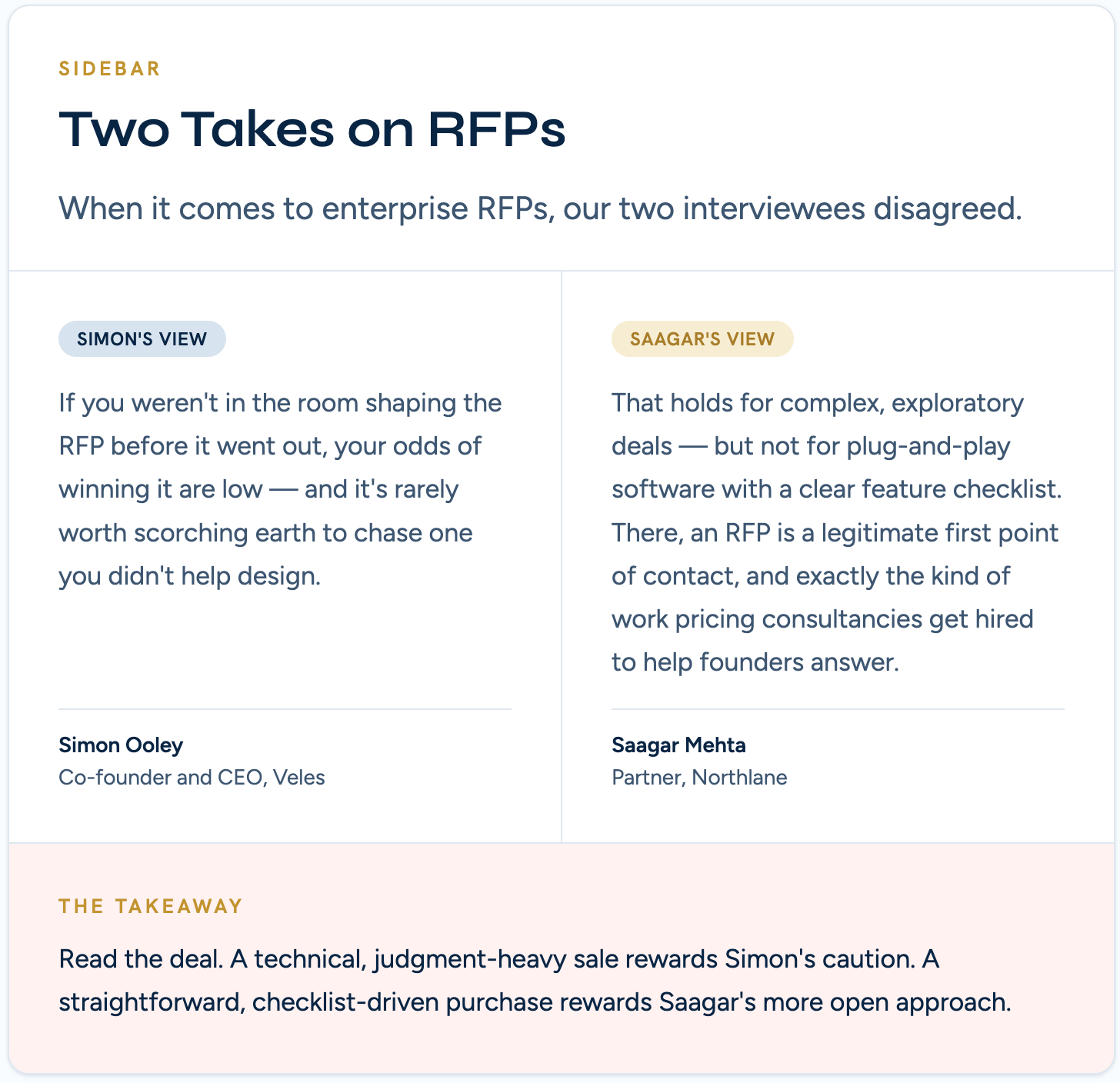
The path to an enterprise motion isn’t linear. Some companies start with a self-serve motion, publish tiers on a pricing page, and eventually land a deal that outgrows them. Others are outbound and enterprise-first from day one, with no self-serve option at all, where every deal is a conversation from the start. Which path you're on is itself a real decision point: is your product ready for self-serve and long-tail demand, or does it need a human in the room for every sale?
If you have a self-serve motion, at some point a deal shows up that doesn't fit your established tiers. How you handle that first "Contact Us" conversation sets the tone for every enterprise deal after it. The trigger for introducing that tier is usually some combination of deal size, seat count, custom integration needs, or security and compliance requirements a self-serve tier can't support.
If you're outbound-first, there's no tier to outgrow since every deal already starts as a custom conversation. The discipline on what to hold firm on and what's negotiable is critical You're simply using it on every deal from day one rather than at the point where a deal graduates out of self-serve.
Structuring for land-and-expand is where many founders stumble. A common early mistake is giving away unlimited usage or every feature up front, which removes your own lever to grow the account later. The fix is building a mechanical way to expand price as the customer grows, whether that's seat growth, module upsells, or usage growth, before you actually need it.
When it comes to multi-year deals, ramp pricing, and minimums, always adhere to the value metric itself and on any strategic trade tied to a discount. What's more negotiable is payment timing, ramp schedules, and non-monetary terms like co-marketing or case study rights.
Discounting Discipline
Discounting Discipline
Setting approval tiers before your first big logo asks for a discount is worth doing before you've ever had to say no. The standard is at roughly 10 percent a rep can approve on their own, 10 to 25 percent needs a first-level approval, 25 to 35 percent needs a second-level approval, and anything above that goes to the founder.
A more granular taxonomy is worth adopting as the team grows. Discounts break out into four types with discretionary rep authority layered on top of all of it:
- Volume-based discounting, i.e., a list price curve tied to seats or usage purchased
- Quid pro quo discounts like annual prepay or case study rights
- Strategic discounts tied to a target logo or new market entry
- Discounting services before software, since a software price cut is harder to recover than a services one
Hot Tip: When a discount threshold exists, reps cluster their asks just under it. A 20% approval gate produces a steady stream of 19% discounts because it's the largest number that doesn't require another signature. Before reaching for a discount at all, it's worth exploring the alternatives: extended payment terms, added services, or deferred start dates all preserve your list price while still giving the rep something to offer.
Common Mistakes Early-Stage Founders Make
Common Mistakes Early-Stage Founders Make
Pricing is a silently compounding error. You could be doing 5x when really you're doing 2.5x, and everyone still looks great.
— Saagar Mehta, Northlane
The most common mistake is underpricing early customers with no plan to change it later. Pricing low to land your first handful of logos can be a smart, deliberate trade rather than a trap, as long as you build it with a reset in mind from the start.
The way to make early pricing work is treating it as a time-boxed decision rather than a default. Tell the customer directly that they're getting founding customer pricing because they're early, and attach a trigger for when it resets (i.e., a specific date, a funding milestone, or a cap on how many customers get that rate). Try to get something back for it too, like a case study, a reference call, or ongoing product feedback. Handled this way, an early customer who helped get you off the ground can move to a market rate later without feeling misled, since the reset was part of the deal from the start.
A close second is giving away unlimited usage or every feature up front. It looks generous, but it removes the mechanism you'll need later to grow revenue from that same account, so it's worth building the expansion lever into your model from the start, even if you don't plan to enforce it early on.
Rounding out the list: copying a competitor's pricing page without validating your own value proposition first, and treating pricing as set it and forget it once you've found product-market fit, when the model that got you there is rarely the one that scales you past it.
Pricing is often treated as nobody's job. It touches every function (sales, product, finance, customer success), which makes it easy for no one to own it. Someone at the company needs explicit responsibility for it, even at seed stage.
Quick-Reference Pricing Health Check
Quick-Reference Pricing Health Check
This self-assessment can help you determine if your pricing needs to be revisited:
- Can you state your value metric in one sentence?
- Do you know your last five deals' actual discount percentage, and do you know why each one landed where it did?
- Is there a documented discount approval process, or does every deal get negotiated from scratch?
- If your best customer's usage grew tenfold tomorrow, would your current pricing capture more of that value, or would you be leaving it on the table?
- Have you changed your pricing in the last 12 months? If not, why not?
- Can your top tier's buyer name what they get that the tier below them doesn't?
Treat pricing like a product you iterate on, not a decision you make once. Companies that revisit pricing regularly outgrow companies that set it once and leave it alone, even when the underlying product is comparable.
We believe once in a generation companies will be built by unexpected founders. If that sounds like you, pitch us here!

Newsletter Signup
