

Artemis Warrior Guide: Startup Financial Operations
October 6, 2025

By The Artemis Fund
The Artemis Fund believes technology can create prosperity for all. With offices in New York, Texas, Massachusetts, and Nevada, Artemis leads seed rounds for companies creating resilient families, individuals, and businesses across the US.
At Artemis, we believe a robust finance function hinges on two critical objectives: optimizing your cash flow to extend your runway and building a compelling financial narrative for future funding rounds.
This guide will help you do both, giving you the foundational understanding of financial reporting, essential cash flow management strategies, and forecasting insights to help you navigate with foresight rather than reaction.
Get The Artemis Fund’s stories in your inbox.
Get The Artemis Fund’s stories in your inbox.
Sign up for our newsletter
Financial Reporting Basics
Financial Reporting Basics
For many founders, financial reporting feels like a back-office chore. But done right, it’s one of your most strategic assets. A well-structured Profit and Loss (P&L) statement is a window into how your business performs, how you make decisions, and how investors perceive your trajectory. Here’s how to get the fundamentals right.
Revenue Recognition
Revenue Recognition
Record revenue when it’s earned, not when the cash hits your account.
- Accrual Accounting: Capture sales when they’re earned, not received, to reflect your company’s true performance over time.
- GAAP (Generally Accepted Accounting Principles): This is the standard rulebook investors and lenders rely on for consistency and transparency. Following GAAP makes your financials credible (and your story believable).
You should also understand the difference between GMV vs. GAAP revenue.
- Gross Merchandise Value (GMV): The total value of transactions processed through your platform — a strong indicator of traction.
- Revenue (GAAP): Your actual cut of those transactions. For example, Uber riders spend $80B in rides (= $80B GMV), but Uber’s revenue is its 30% share (= $24B Revenue).
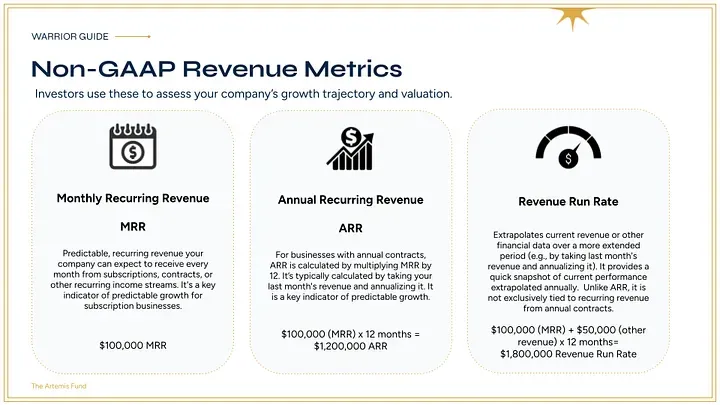
- Non-GAAP Revenue Metrics: Investors may also track recurring revenue metrics to understand your growth trajectory and valuation potential.
Expenses
Expenses
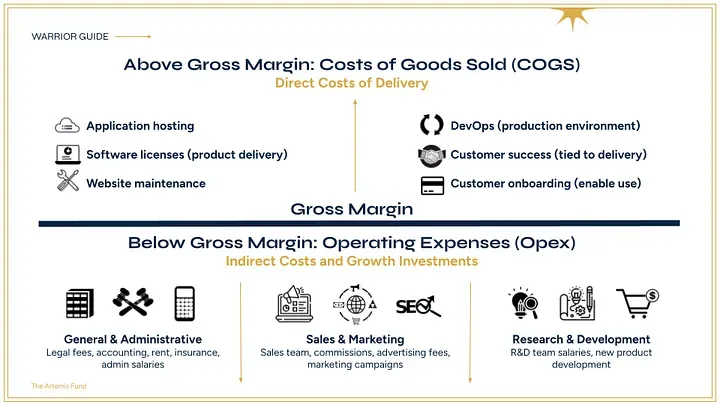
Every dollar that leaves your company should have a purpose. Expenses typically fall into two categories:
- Cost of Goods Sold (COGS): Direct costs to produce or deliver your product or service. Lower COGS relative to revenue = higher gross margins.
- Operating Expenses (Opex): Everything else — sales, marketing, R&D, G&A, etc.
When in doubt, ask yourself:
“Can my customers use or receive the product without this expense?” If no, it’s COGS. If yes, it’s likely Opex.
Once you understand what drives your margins, you can start optimizing for efficiency.
Cash Flow Tracking and Management
Cash Flow Tracking and Management
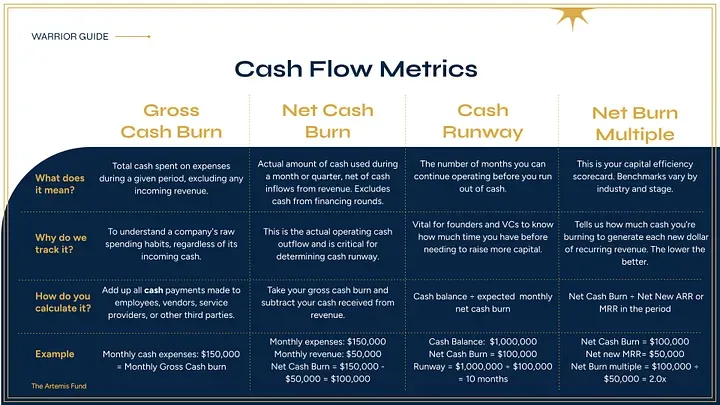
It doesn’t matter how great your company is if you run out of cash. At Artemis, we monitor three core metrics across all our portfolio companies: cash burn, runway, and burn multiple. These are your financial lifelines.
Why These Metrics Matter:
- Runway (Buy Yourself Time): Knowing your runway allows you to adjust costs strategically — not while you’re in crisis mode. Start fundraising six to nine months before your cash runs out.
- Capital Efficiency (Maximize Your Resources): The longer your capital lasts, the more time you have to iterate, find product-market fit, and hit fundraising milestones.
- Risk Assessment (Build Investor Confidence): Investors track how efficiently you manage capital. Strong burn discipline signals resilience, especially in tight markets.
Once you’re tracking these metrics, the next step is forecasting, so you can see challenges before they hit your bank account.
Cash Flow Forecasting
Cash Flow Forecasting
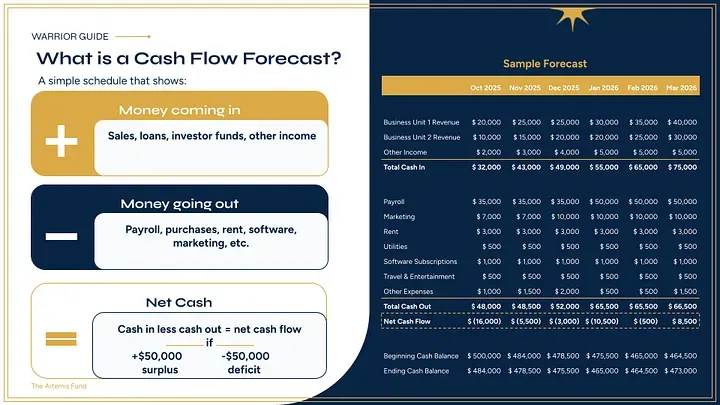
A cash flow forecast is one of the most powerful tools in a founder’s arsenal. It projects your inflows and outflows, helping you spot problems before they become emergencies.
How often to forecast:
- 18+ months of runway: Update quarterly.
- 12–18 months: Review assumptions monthly; reforecast quarterly.
- <12 months: Forecast weekly (yes, weekly). If payroll in week 7 pushes you negative, you’ll know now, not the night before.
The standard is a 13-week cash flow forecast, since most cash crunches appear within that window. Update it as new information arises and act fast when the data shifts.
Thinking Three Moves Ahead
Thinking Three Moves Ahead
A good forecast tells you what might happen. A great one shows you what to do if it does. Scenario planning helps you build multiple versions of your forecast, so you can model both risk and opportunity.
Build at least three cases:
- Best Case: Faster growth, successful fundraising.
- Base Case: Most likely path.
- Worst Case: Slow sales, delayed funding, or surprise costs.
Here’s what this practice enables:
- Spot Problems Early: See cash shortages or surpluses before they arrive.
- Make Strategic Choices: Adjust hiring, expenses, or fundraising timing before pressure builds.
- Build Credibility: Showing investors you’ve modeled multiple outcomes signals strategic maturity and foresight.
When you understand your financial story, you make sharper decisions, navigate uncertainty with confidence, and earn trust from both your investors and your team. At Artemis, we partner closely with our portfolio companies to strengthen their financial foundations and prepare them for every phase of growth. When you master financial operations, you master time management, trust, and trajectory. When founders get that right, they scale with purpose.
We believe once in a generation companies will be built by unexpected founders. If that sounds like you, pitch us here!

Newsletter Signup
