

Artemis x Spoke Warrior Guide: Building a Sales Function from Zero to One
April 2, 2026

By The Artemis Fund & Spoke
The Artemis Fund believes technology can create prosperity for all. With offices in New York, Texas, Massachusetts, and Nevada, Artemis leads seed rounds for companies creating resilient families, individuals, and businesses across the US.
Spoke is a people infrastructure partner that helps startups build cost-effective global teams through embedded recruiting and talent operations. With a 92% retention rate (vs. 68% industry average) and operations across the US, Latam, Philippines and Eastern Europe, Spoke helps founders build better teams from Day 1.
You've built something people want. You've closed your first customers. Now you're staring at a calendar full of sales calls, a product roadmap that needs attention, and a board that wants to see revenue growth. The obvious solution: hire someone to take sales off your plate.
Here's why that instinct is dangerous. 70% of first VP Sales hires at SaaS startups don't make it 12 months.¹ The average tenure of a sales leader in tech is just 19 months.² And when these hires fail, they don't fail quietly. They take deals, momentum, and sometimes entire teams with them. Dr. Bradford Smart, author of Topgrading, estimates bad hires cost between 5-27x a person's salary.³
The failure rate isn't because good sales talent doesn't exist. It's because founders consistently hire the wrong person, at the wrong time, for the wrong job. This guide will help you avoid that trap.
Get The Artemis Fund’s stories in your inbox.
Get The Artemis Fund’s stories in your inbox.
Sign up for our newsletter
Don't Skip Founder-Led Sales
Don't Skip Founder-Led Sales
Before you hire anyone, you need to sell. Not because you're the best salesperson (you're probably not), but because you're the only person who can figure out what actually works.
Jason Lemkin's advice: close at least 10 customers yourself before hiring your first sales rep.⁴ Peter Kazanjy takes it further: do at least 50 sales demos with a win rate between 15-25% before you bring anyone on.⁵
Why so many? Because every conversation teaches you something:
- What messaging actually resonates
- What objections you'll hear over and over
- Who your real ICP is (not who you think it is)
- What your sales cycle actually looks like
- Whether your pricing works
Without firsthand knowledge, you can't train a sales hire. You can't evaluate whether they're doing a good job. You can't tell the difference between "this isn't working" and "I hired the wrong person."
The trap to avoid: "I'll just hire a VP of Sales and get back to product."
The trap to avoid: "I'll just hire a VP of Sales and get back to product."
This is the most expensive mistake founders make. You're not hiring someone to figure out sales for you. You're hiring someone to scale what you've already figured out. If you hand off a blank slate, you're paying $200K+ for an experiment that usually fails.
Signs you're ready to hire:
1. You have a repeatable way to acquire customers
2. You're capacity-constrained ("If I had more time, I could close more deals")
3. You can clearly articulate what's working
4. Your customers are sticking around (you're not churning them as fast as you close them)
Understand the Hiring Sequence
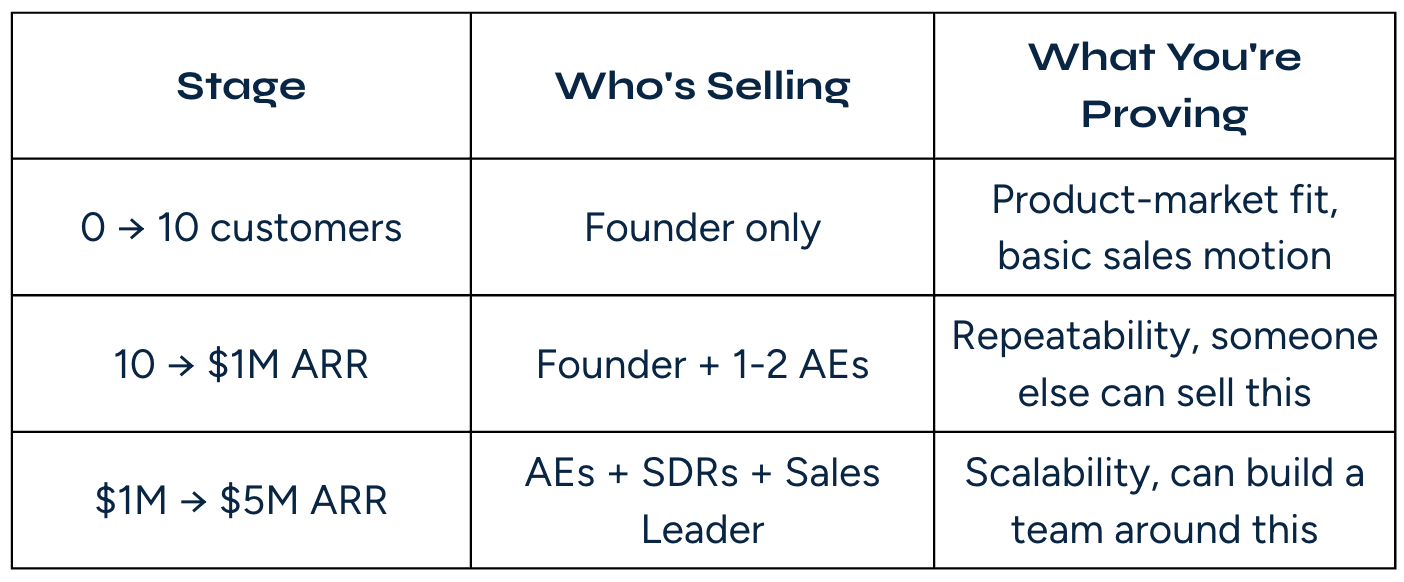
Most founders get the order wrong. Here's the sequence that actually works:
Ultimately, you don't hire a VP of Sales to figure out your sales process. You hire them to scale one that's already working. our first sales hire should be a full-cycle Account Executive who can do everything: prospecting, demos, closing.
Lemkin calls this the "first 2 reps" rule: hire two AEs (not one) so you can A/B test and learn what works.⁴ If you only hire one and they fail, you won't know if the problem was them or your process.
What to look for:
- Startup experience (people from big companies often struggle without resources)
- Comfort with ambiguity
- Willingness to prospect their own deals
- Experience at your price point (selling $3K deals is different from $300K deals)
Red flags:
- "I need an SDR to feed me leads"
- Talks more about OTE (On-Target Earnings) than about your mission
- Can't explain how they generated pipeline at their last company
- Only has experience at companies with established brands
Match Your Org Structure to Your ACV
Match Your Org Structure to Your ACV
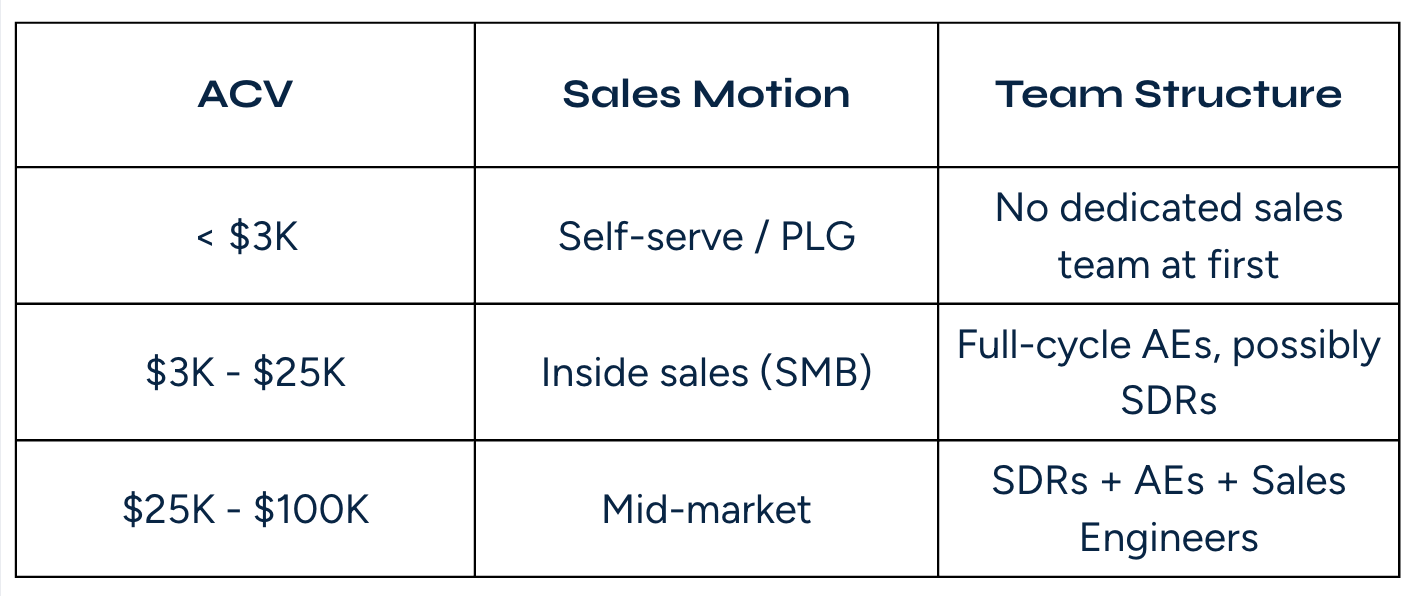
Your annual contract value determines what kind of sales organization you can afford to build. The math is simple: a salesperson's quota needs to be high enough to justify their compensation.
Tomasz Tunguz puts it bluntly: at a $500 price point, an AE with a $500K quota would need to close 4.2 customers per working day. That's not realistic.⁶ The math starts working around $3K ACV for inside sales.
The SDR Question
The SDR Question
SDRs make sense when your AEs are spending too much time prospecting and not enough time closing. According to Bridge Group data, an SDR team has positive ROI when ACV is above $8K.⁷ Below that, the economics don't work.
Don't hire SDRs before you have a working outbound playbook. If you don't know what messages get responses, an SDR will just send more bad messages.
Consider Fractional Before Full-Time
Consider Fractional Before Full-Time
A full-time VP of Sales typically costs $250K-$350K in total compensation, while a fractional sales leader costs typically $6K-$15K per month.⁸
For seed-stage companies, fractional often makes more sense:
- Lower risk: You get senior expertise without a 6-figure bet
- Faster onboarding: Most can develop a strategy in 30-60 days
- Built-in flexibility: Scale up or down based on what you learn
- Cross-pollinated expertise: They bring patterns from working with multiple companies
When fractional makes sense:
- You need to build sales infrastructure (CRM, comp plans, playbooks) but don't have the expertise
- You're not ready for a full-time hire but need strategic guidance
- You want to validate your sales motion before committing to a large hire
When full-time makes sense:
- You have significant revenue traction (approaching $1M ARR)
- Strong retention (no leaky bucket)
- You need someone to build and manage a team, not just advise
Build Infrastructure Before You Hire
Build Infrastructure Before You Hire
Even a great sales hire will fail if you drop them into chaos. Before you bring someone on, have these basics in place.
CRM Setup: It doesn't need to be fancy. HubSpot Free or a simple Salesforce instance works. What matters is that you're tracking deals, stages, and conversion rates. If you don't have data on your current process, your new hire can't improve it.
Compensation Plan: For startups, a 60/40 or 70/30 base-to-variable split is standard.⁹ Higher base gives you flexibility when your process is still unproven. Don't get too creative. Simple plans (quota + commission rate) work better than complex ones with multiple accelerators.
Sales Playbook (Basic)
Document what you've learned from founder-led sales:
- ICP definition (who buys, who doesn't)
- Common objections and responses
- Talk track / demo flow
- Pricing and negotiation guardrails
- Typical sales cycle and stages
What Investors Look For in Your GTM
What Investors Look For in Your GTM
At Series A, investors care about whether you can scale. Here's what they're evaluating:
- Repeatability: Can someone other than the founder close deals? Do you have a defined ICP and sales process, or are you still figuring it out?
- Unit Economics: What's your CAC? LTV:CAC ratio? Payback period? If you don't know these numbers, that's a red flag.
- Retention: Hiring salespeople to fill a leaky bucket is a recipe for cash burn. Net revenue retention above 100% tells investors your product works. Put simply: your existing customers are generating more revenue over time, even after churn.
- Hiring Ability: Can you attract talent? Have you built a culture where salespeople want to work? Churning through reps every 6 months is a warning sign.
- Founder Involvement: Founders who are still involved in sales (especially on strategic deals) signal that they understand the customer. Founders who've completely stepped away often don't know what's actually happening in the market.
The question investors are really asking: "If we give you $10M, can you turn it into a $100M revenue business?"
The question investors are really asking: "If we give you $10M, can you turn it into a $100M revenue business?"
Your sales function is how you demonstrate that you can. A repeatable sales process with strong unit economics is proof. A revolving door of failed sales hires is evidence that you can't.
The Global Advantage
The Global Advantage
One way to stretch your sales budget: build part of your team globally.
An SDR in San Francisco costs $65K-$80K base. An equally capable SDR in Manila or Bogotá costs $20K-$30K.¹⁰ That's not a quality tradeoff. It's an arbitrage opportunity.
Global teams work particularly well for:
- SDR/BDR functions (prospecting, research, outreach)
- Sales operations (CRM management, reporting, enablement)
- Customer success and account management
The key is to approach it as a strategic advantage, not cost-cutting. Invest in management, training, and integration. Companies that treat offshore teams as second-class get second-class results.
Building a sales function isn't about finding a magical VP who will take revenue off your plate. It's a sequence:
- Sell first. Close enough deals yourself to understand what works.
- Hire doers, not managers. Your first sales hires should be AEs who can prospect their own deals.
- Match structure to ACV. Don't build an enterprise sales team for an SMB product.
- Consider fractional. Get expertise without the full-time commitment until you're ready.
- Build infrastructure. Don't drop hires into chaos.
- Stay involved. Founder-led sales never really ends. It just evolves.
The founders who get this right build sales teams, while building revenue engines that investors want to fund.
Need Help Building Your Sales Function? Spoke helps seed-to-Series A startups build and scale their go-to-market teams the better way. From fractional sales leadership to recruiting your first AEs to building SDR teams globally, we've helped dozens of founders navigate the zero-to-one sales journey. Reach out to LaToya at latoya@gospoke.co.
Artemis believes once in a generation companies will be built by unexpected founders. If that sounds like you, pitch us here!
Sources
¹ Jason Lemkin, SaaStr: "The majority of first VP Sales in SaaS companies don't make it 12 months."
² Amy Volas, Avenue Talent Partners: "The average sales leader in tech only lasts roughly 19 months."
³ Dr. Bradford Smart, Topgrading: Bad hire costs range from 5-27x salary.
⁴ Jason Lemkin, SaaStr: Founder sales sequence and first 2 reps rule.
⁵ Peter Kazanjy, Founding Sales: 50 demos with 15-25% win rate before hiring.
⁶ Tomasz Tunguz: ACV math for inside sales teams.
⁷ Bridge Group: SDR team ROI analysis by ACV.
⁸ Multiple sources: Fractional sales leadership typically costs $6K-$15K/month vs $250K-$350K for full-time VP Sales.
⁹ Winning by Design: Startup sales compensation best practices.
¹⁰ Spoke internal data: Global salary benchmarks for SDR roles.

Newsletter Signup
