

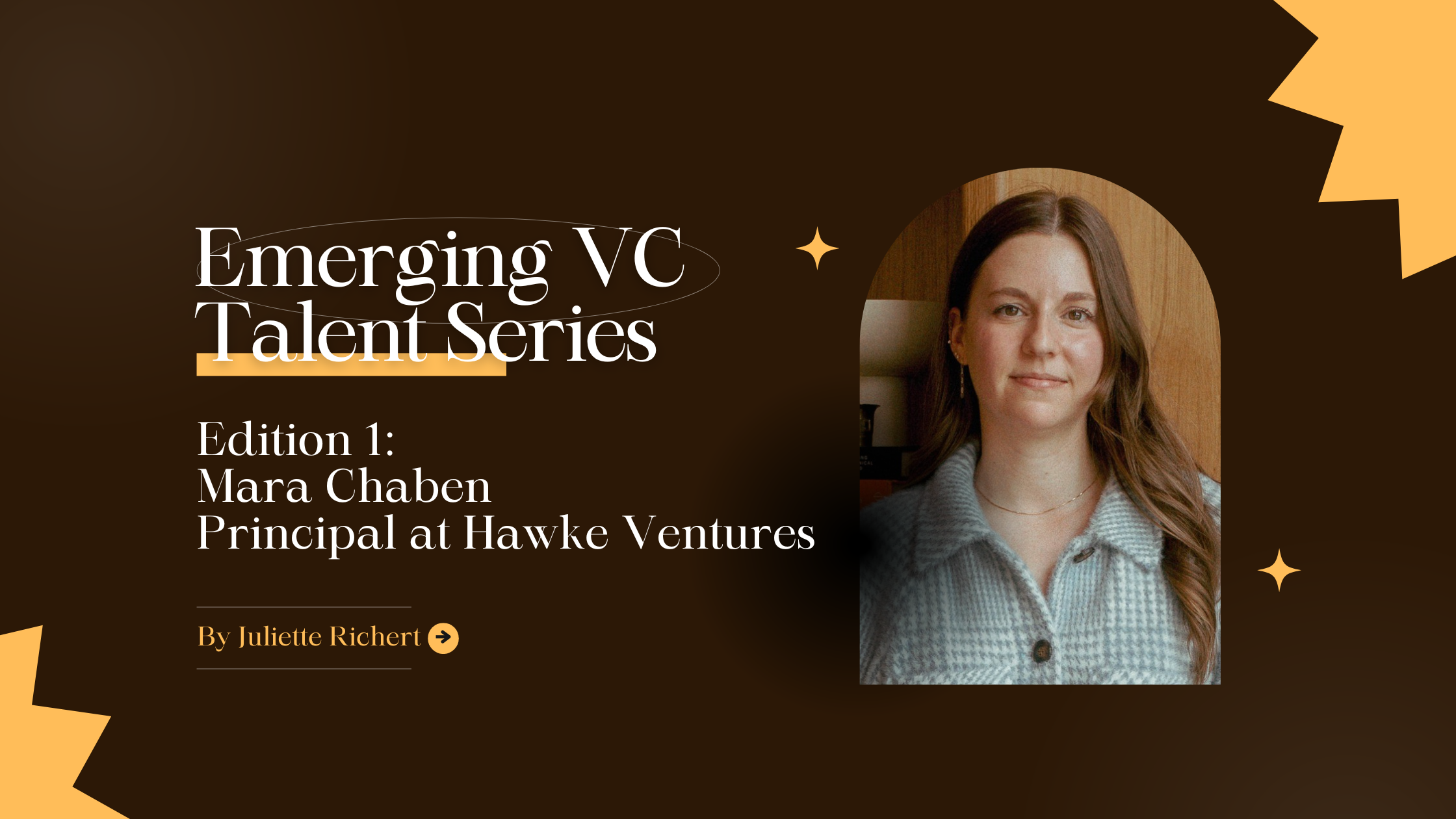
Emerging VC Talent: Edition 1, Mara Chaben
July 20, 2024
By Juliette Richert
The Artemis Fund believes technology can create prosperity for all. With offices in New York, Texas, Massachusetts, and Nevada, Artemis leads seed rounds for companies creating resilient families, individuals, and businesses across the US.
Welcome to my monthly interview series on emerging VC talent! We talk everything from gathering insights on emerging industries and tech, to venture dynamics, to career-best practices.
In the inaugural edition, I interviewed Mara Chaben, Principal at Hawke Ventures. Hawke Ventures is an early-stage venture fund that invests in Commerce Enablement Tech, MarTech and AdTech.
TL;DR: Key Takeaways
- Hot Take: At the core, investors are nurturers. Mindfulness and presence are underestimated tools.
- Best Practices: Develop an ownership mindset, practice active listening, and be open to trying new things.
- Setting Up for Success: A good mentor invests in your growth, connects you with key people, and nudges you out of your comfort zone. When exploring a new industry, network with experts, and share insights for mutual value.
- Industry Outlook: Possibly fewer dollars flowing into independent funds, private companies staying private longer, and CVCs coming out on top.
Get The Artemis Fund’s stories in your inbox.
Get The Artemis Fund’s stories in your inbox.
Sign up for our newsletter
Juliette: What was your first job?
Mara: I actually worked at the camp where I spent my childhood summers. I was the water ski instructor on Lake Huron, so I drove the boat all summer long and taught kids how to water ski. It was still the best job I’ve ever had.
Juliette: How do you spend your time outside of work? Can you speak to any professional applications or learnings?
Mara: I’m a big yogi and practice yoga multiple times a week. I also work out and hike a lot. Yoga and working out teach you to do hard things and to be patient and non-reactive, even when facing challenges. These lessons are invaluable in navigating the ups and downs of startups and venture.
I also practice mindfulness and meditation, which foster empathy. This job requires a lot of listening and mindfulness. When talking to founders, it’s easy to get ahead of the conversation, but staying present is crucial to fully understand their vision and goals. Mindfulness helps me stay focused and present during these discussions.
Being thoughtful is also important. For example, thinking about how you can support your portfolio companies, such as making valuable introductions.
This role is really about nurturing and supporting the growth of the companies we invest in.
Juliette: What was the biggest skill you had to learn/up-level to be a great associate and ultimately get promoted to principal?
Mara: One of the biggest skills I had to develop was the willingness to roll up my sleeves and take ownership. Anticipating issues before they arise and proactively addressing them is key, especially on a small team. For example, identifying ways to improve fund operations, diligence processes, or sourcing strategies.
Coming from an entrepreneurial background, I bring an owner’s mindset to my role in VC. I recommend this perspective regardless of your position. Taking ownership of improving the firm will push you to up-level your skills.
Another crucial skill is being open to learning new things and taking on tasks outside your comfort zone. In VC, many people shy away from certain responsibilities, but embracing them can lead to significant growth. For instance, I’m currently planning a large LP Summit — something I never expected to do — but it’s been a valuable learning experience.
Active listening is also vital. Whether in investment committee meetings or founder calls, listening and learning from every interaction is essential- every new tidbit stacks on your knowledge. Additionally, reading newsletters, doing research, and staying informed about portfolio companies are crucial for building your knowledge base. Make sure you’re reading every portfolio company update, because understanding their strengths and challenges can be applied in other situations.
Lastly, mindfulness and presence are fundamental. Being fully present in conversations helps you understand founders’ visions and needs, ultimately making you a better VC.
Juliette: What makes a great mentor?
Mara: A great mentor is someone who actively invests in your growth by making introductions, representing the brand, and involving you in important calls. Drew Leahy, the Managing Partner who brought me into Hawke Ventures, exemplifies this.
When I joined, I didn’t know much about VC. I had taken Drew’s 12-week course for underrepresented individuals in VC, which was my introduction to the profession. Shortly after completing the course, I joined the Hawke Ventures team.
Drew was instrumental in my development, introducing me to people, opening doors, and providing opportunities. He involved me in important calls and encouraged me to speak. Drew also pushed me out of my comfort zone, encouraging me to tackle challenging tasks and figure things out on my own. Whenever I felt lost, he was there to guide me. I’m really grateful for Drew’s mentorship and the confidence it gave me.
This experience taught me that you become qualified for something the moment you start doing it, even if you don’t initially feel prepared.
Juliette: How do you learn about a new industry quickly?
Mara: I feel like I have maybe a little bit of a different experience in this because I’m so focused on one niche market. Here’s my approach:
- Stay Informed: I read a lot of industry newsletters and keep an eye on current events. Understanding the changes happening today and their potential impacts on the future is essential. I’m constantly on X, or googling to find relevant information and insights on breaking news and expert opinions.
- Network with Experts: Talking to people who are actively operating in the space is invaluable. I often share tools and ideas with colleagues at Hawke’s marketing agency, and they quickly point me in the right direction. Building a network of experts across various industries provides diverse perspectives and resources.
- Mutual Value Exchange: Operators are often curious about innovation and new technologies. Sharing insights about emerging companies and technologies can be very beneficial for them. While their primary focus isn’t on finding new opportunities, ours is, so it’s a mutual value add.
Juliette: What industry are you bullish on?
Mara: I’m very bullish on ad fraud detection, which is a significant opportunity in the ad tech space. Ad fraud involves bots and non-human entities clicking on ads, leading to wasted marketing dollars. While platforms like Google have measures to block bots, they lack transparency about how much of your ad spend is actually wasted. This makes ad fraud detection a crucial area for innovation and improvement.
Juliette: Where do you see the VC/PE industry going?
Mara: It’s a really interesting time in the market. There are fewer dollars flowing into independent funds because many LPs and founders haven’t seen returns or exits. Private companies are staying private longer, raising questions about how and when VCs can start returning funds. This might lead to an increase in secondary transactions and potentially more regulation of private markets, similar to public markets. The performance of current funds won’t be clear for some time, so it will be fascinating to see how things play out. Despite the uncertainties, there are opportunities to succeed.
I’m particularly curious about corporate venture capital (CVC). On one hand, CVCs can be highly strategic for portfolio companies, providing financial returns for both the startups and their corporate backers. However, there are concerns about proprietary technology and larger companies having access to it, which poses risks. Long-term, I wonder if CVCs and well-known funds with substantial cash reserves will be the ones that endure.
In the emerging manager landscape, I’ve noticed new funds buying up smaller, emerging funds (e.g., $5–10M funds). This trend of merging emerging funds is intriguing, since it involves combining LPs and portfolio companies to grow together. However, partnerships are crucial, and GP relationships can deteriorate quickly. Even in my relatively short time in venture, I’ve seen this happen frequently.
Juliette: What’s the first company you fell in love with?
Mara: I love Superfiliate. Superfiliate is a software platform that helps brands run word-of-mouth programs and create personalized digital storefronts. The platform’s goal is to improve the customer and creator experience, and to generate ROI-driven storefronts.
Juliette: Biggest learning or piece of advice?
Mara: Especially in VC and startups, hard work isn’t going to pay off for a long time. Sometimes things feel like they’re moving slower, but then you look back and realize how far you’ve come.
Be patient. Only things worth working for take time.
We believe once in a generation companies will be built by unexpected founders. If that sounds like you, pitch us here!

Newsletter Signup
