

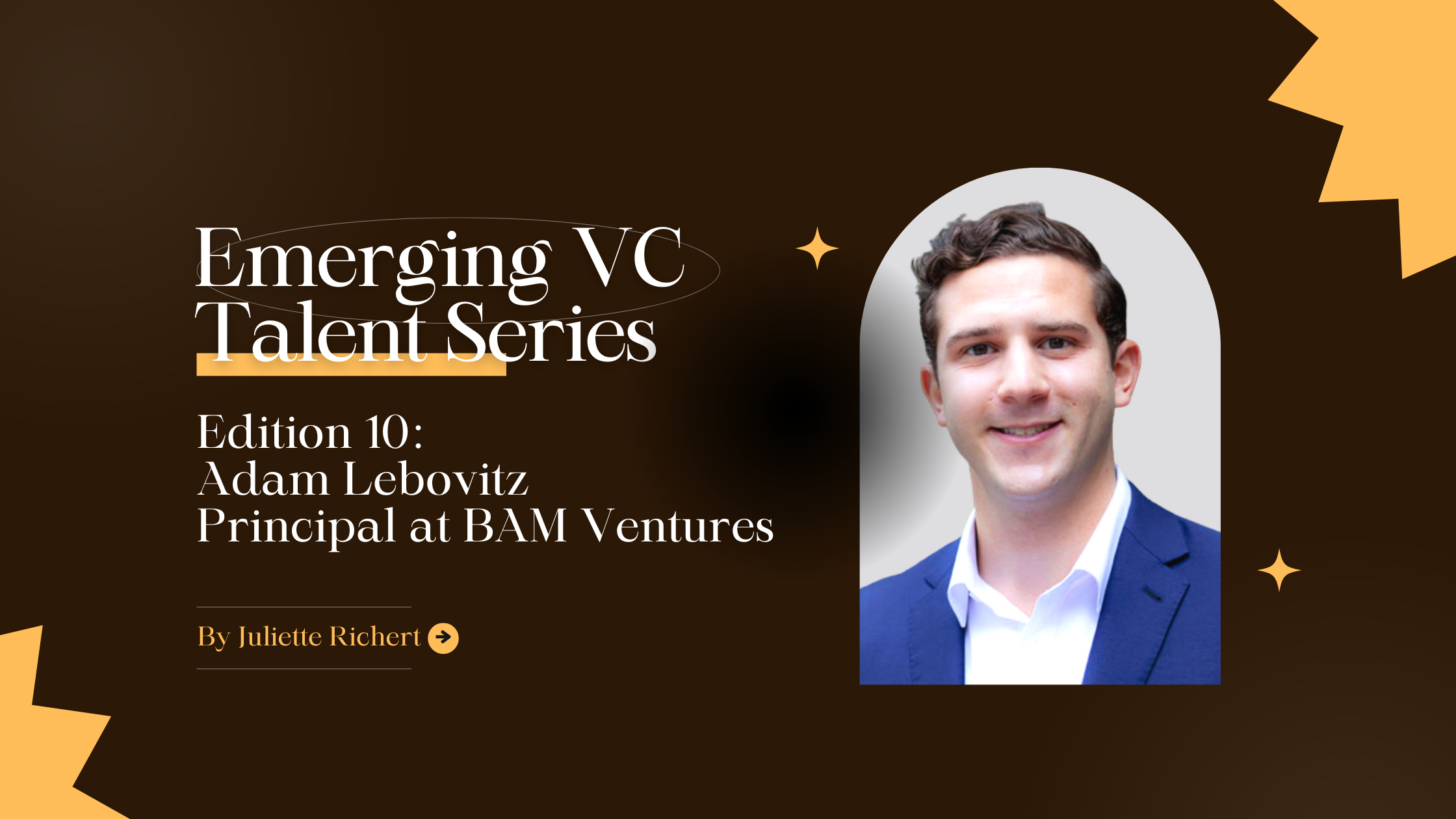
Emerging VC Talent: Edition 10, Adam Lebovitz
July 10, 2025
By Juliette Richert
The Artemis Fund believes technology can create prosperity for all. With offices in New York, Texas, Massachusetts, and Nevada, Artemis leads seed rounds for companies creating resilient families, individuals, and businesses across the US.
Welcome to my monthly interview series on emerging VC talent! We talk everything from gathering insights on emerging industries and tech, to venture dynamics, to career-best practices.
In the tenth edition, I interviewed Adam Lebovitz, Principal at BAM Ventures, an early-stage consumer-focused fund focused on investing in the builders of tomorrow’s iconic brands and technologies.
TL;DR: Key Takeaways
- Hot Take: Consumer boredom can be a feature, not a bug, in CPG. As consumers, people stay curious and want to try new things. That means great packaging, differentiated positioning, or cultural timing can make people try a new product in ways that SaaS never can.
- Best Practices: When diligencing a consumer deal, the key is to understand team-to-consumer fluency. The founders don’t have to represent the target market, but need to deeply understand how that customer thinks, feels, and buys.
- Market Insight: With valuations down, capital scarce, and strategic acquirers still active, early-stage investors have a rare chance to enter the consumer and CPG market at compelling prices, capturing alpha while everyone else looks the other way. For founders, it’s a moment to build default-alive businesses that unlock a broader set of financing options.
Get The Artemis Fund’s stories in your inbox.
Get The Artemis Fund’s stories in your inbox.
Sign up for our newsletter
Juliette: What was your very first job?
Adam: I was a lifeguard and summer club water polo coach during high school and college. I worked at one of those old tennis clubs near where I grew up. I started off as a lifeguard and taught swim lessons, then eventually coached water polo.
Juliette: How do you spend your time outside of work? Any connections to how you think professionally?
Adam: I’m a big skier, and there’s a strong overlap between skiing and investing. There’s the “practice makes perfect” side: putting in the reps, building muscle memory. But there’s also the unpredictability. You never really know what conditions you’re going to get. Growing up swimming and playing water polo, my coach always talked about “uncontrollables.” That stuck with me. The same goes for investing: the macro climate, deal flow, market sentiment. There’s only so much you can control. You know, you never know if you’re gonna have six feet of snow or or no feet of snow.
Two years ago when I was skiing, I hit a patch of snow, my ski came off, I landed on a tree, and broke my collarbone. That’s investing sometimes. You prepare as best you can, but you also have to be prepared for what you don’t see coming, and react accordingly.
Juliette: How long have you been in venture? Can you walk me through your path to BAM?
Adam: I studied political science at Princeton and originally thought I’d become a lawyer. My first job out of college was as a paralegal in New York while I studied for the LSAT, where I quickly realized law wasn’t for me.
Then I moved to LA to work for a family office that launched a movie studio. The idea was to invest in tech, media, and entertainment startups using our operating lens to shape the thesis. But three weeks in, my boss was named CFO, and we were suddenly running finance and operations. For three and a half years, I split my time between capital allocation and fixing whatever was broken in the business.
That role showed me how venture works: part investment judgment, part portfolio problem-solving. I saw both sides: how to deploy capital, and how to support the business once you’ve invested. When I was there, I realized I wanted to do venture.
From there, I went to business school, interned at Curology between years, did a research fellowship with Goodwater, and finished my MBA while interning at Slow Ventures. After that, I joined Touchdown Ventures in 2020 and spent two years there before joining BAM a little over two and a half years ago.
Juliette: How is BAM different from Touchdown in terms of how you approach investing?
Adam: The biggest differences come from stage, strategy, and check size. At Touchdown, we worked with corporate partners and wrote slightly larger checks, usually at a later stage. That meant we had more data to dig into, like financials, traction, customer metrics.
At BAM, we’re investing much earlier, often at concept or pre-seed, so we spend a significant amount of time on qualitative factors. Everyone says they’re founder-focused, but at BAM we really mean it. Given our operational DNA, and one of our Partner’s background as a serial entrepreneur, we spend a lot of time trying to understand team-market fit and team-product fit.
In consumer especially, the team doesn’t always need to be the consumer, but they need to deeply understand the consumer. That includes knowing how to speak to pain points, communicate value, and build trust. We try to identify fluency in how strong founders talk about their category, their product, and their customer.
Juliette: How do you think about consumer decision-making? What signals do you look for?
Adam: Consumer decisions are incredibly complex and deeply personal. Everyone says they want to be healthier, but that doesn’t mean they’ll pay more for the healthier option, especially if it doesn’t taste as good or isn’t as convenient.
We try to understand what actually drives decisions at the point of purchase. For example, with better-for-you food, if two products are identical but one has a cleaner nutritional profile, that’s great, but only if taste, price, and branding are also competitive. We ask: what trade-offs are consumers really willing to make?
At BAM, we think a lot about sub-markets, not just total addressable market. Everyone says their product is for “everyone,” but real market opportunity is about specific, reachable, and willing-to-pay audiences.
Juliette: What role does consumer research play, especially when the team isn’t the target customer?
Adam: It’s huge. There’s value in reading: industry reports, media cycles, trend forecasts. For example, we saw this anti-dairy wave a few years ago, and now whole milk is making a comeback. Consumer behavior is cyclical and cultural.
We also do a lot of direct outreach. Our team is diverse, so if we all like something, that signals broader appeal. Sometimes it’s as simple as texting friends or asking people at a bar what they think of a product. You can learn a lot just by handing someone a sample and watching their reaction, whether it’s to the packaging, the taste, or the experience.
Consumer is a discovery-based category. People want to try new things. That’s the unlock in consumer, trial creates opportunity.
Juliette: People seem down on consumer these days. Why are you still excited about it?
Adam: I love that everyone’s down on consumer… It means there’s alpha. If everyone’s running in one direction, we’re probably looking in the right place by going the other way.
From a macro standpoint, consumer spending is still 70 percent of U.S. economic activity. Three of the five largest companies in the world are consumer tech companies. There were nearly 250 consumer acquisitions in the $300M-$500M range in 2023. Especially if the company doesn’t raise a ton, the elements for venture-scale outcomes are still there.
The misconception is that consumer products can’t be venture-backed because the exits are smaller than software. But that ignores capital efficiency. You don’t need a billion-dollar exit to return the fund if you invested early at the right valuation. The key is finding businesses that can grow without burning tons of cash. Businesses that can stand on their own two feet.
Juliette: On the capital side, the pullback in consumer might help at entry, but how do you think about downstream fundraising? Are there Series A funds still investing in CPG, or are founders seeking other capital sources?
Adam: Series A has definitely gotten harder in CPG. That’s something we’re hearing directly from founders. The silver lining is that it’s forcing companies to build with profitability in mind from day one, and I think that’s a good thing.
If you can use your pre-seed and seed capital to build a fundamentally sound business, you have optionality. You don’t have to rely on equity rounds to sustain your business. You can explore inventory financing, revenue-based financing, strategic partnerships, and even distributors who want to invest. You shift from needing to raise to choosing when and how to raise.
That flexibility changes the whole trajectory. If you raise $1M at a $5M post and sell the company for $100M while still owning 80%, that’s a phenomenal outcome. The multiple is great, the dilution is low, and everyone wins. The check size might not be huge, but the return is. And that’s what matters.
Juliette: That changes how you think about portfolio construction too, in that not every win needs to be a unicorn.
Adam: Exactly. You start by asking: can this business stand on its own two feet? If the answer is yes, there will be financing options, and optionality is power.
Juliette: Let’s talk about your professional growth. As you’ve gained seniority, have there been any key unlocks in how you operate as an investor?
Adam: Definitely. A lot of what you learn in venture only comes from getting the reps in. People talk about pattern recognition, but it’s really about understanding the cycles: the first deal you lead that doesn’t go well, the gut checks, the moments where you realize what you missed and why.
It’s not always about judgment being “wrong.” Sometimes you were too excited about a category, or didn’t backchannel enough, or underestimated how much the founder really lived the problem they were solving. Every deal is a whole business. You’ll never have perfect information. But with experience, you learn how to quickly identify the biggest outstanding questions. You get sharper at prioritizing what matters.
You also develop fluency. Is this a mass market category with room for 10 players, or is it a winner-take-all space? That shapes how deep you go into competitive analysis, how you think about risk, and how you approach conviction.
And at the end of the day, venture is a human business. Yes, there’s analysis, but it’s also about your network, who’s sending you deals, how you support founders, and how well you connect with people. You’re getting into long-term partnerships, so you want to know not just what you’re backing, but who. You kind of get married in every deal, and like in real life, you get better at it over time.
We believe once in a generation companies will be built by unexpected founders. If that sounds like you, pitch us here!

Newsletter Signup
