

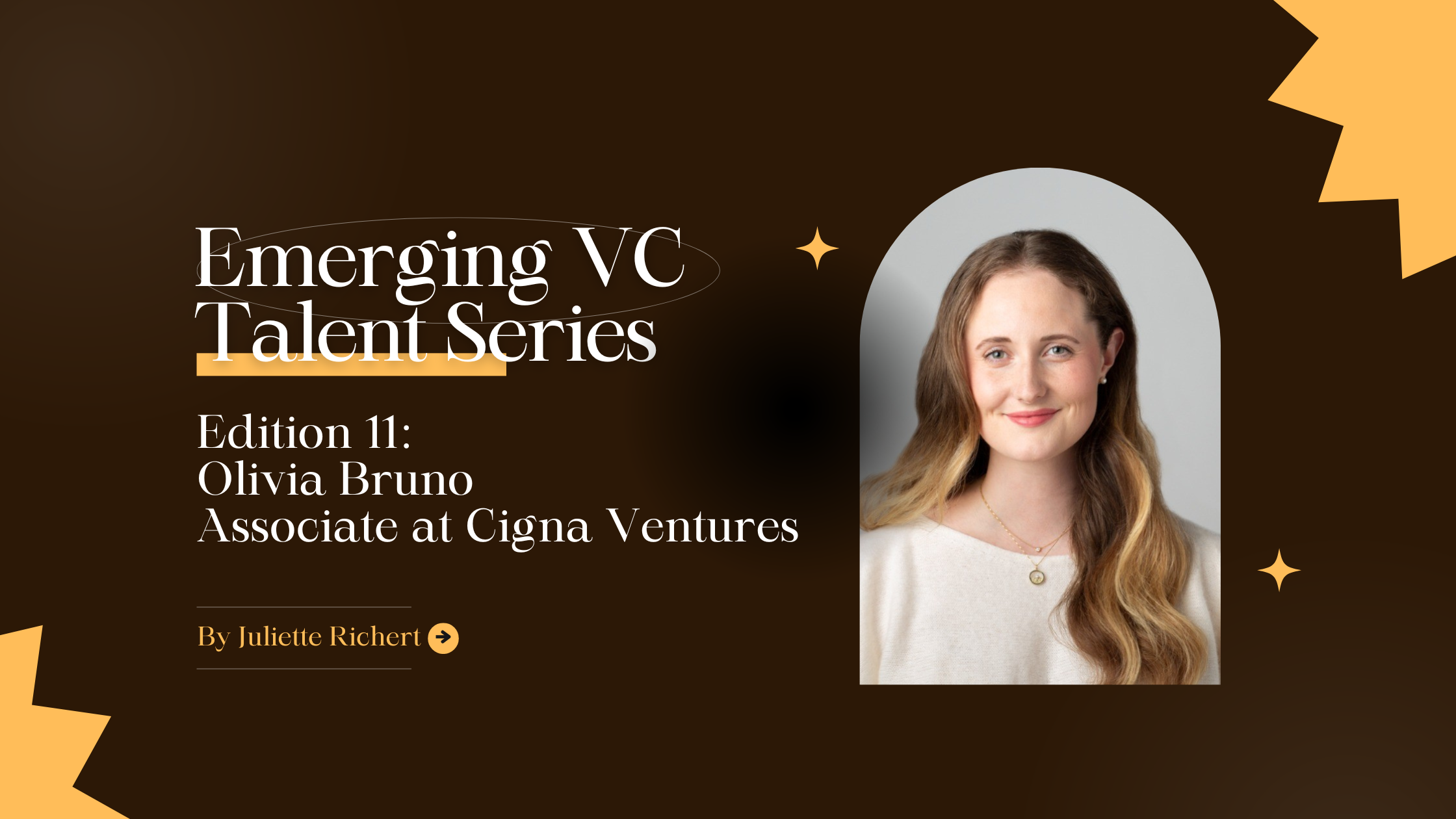
Emerging VC Talent: Edition 11, Olivia Bruno
November 12, 2025
By Juliette Richert
The Artemis Fund believes technology can create prosperity for all. With offices in New York, Texas, Massachusetts, and Nevada, Artemis leads seed rounds for companies creating resilient families, individuals, and businesses across the US.
Welcome to my monthly interview series on emerging VC talent! We talk everything from gathering insights on emerging industries and tech, to venture dynamics, to career-best practices.
In this edition, I interviewed Olivia Bruno, Associate at The Cigna Group Ventures, the strategic venture fund of The Cigna Group, a leading global health service company with more than 190 million customer relationships in more than 30 countries.
TL;DR: Key Takeaways:
- Hot take: Associates aren’t just gatekeepers. They’re the ones who truly sell a deal inside the firm, so founders’ trust in you is as critical as your IC memo.
- Best practices: Learn to pressure-test founder claims by validating market sizing and growth drivers, digging into data rooms, and mapping the competitive landscape with rigor.
- Setting up for success: Persistence and thoughtful outreach (the same hustle Olivia used to land her first role) is still a reliable way to break into venture.
Get The Artemis Fund’s stories in your inbox.
Get The Artemis Fund’s stories in your inbox.
Sign up for our newsletter
Juliette: You just joined The Cigna Group Ventures. What are you focused on there?
Olivia: At The Cigna Group, we’re a pure strategic investor. Our check sizes start at $5M, which typically puts us at Series A or later, though Series B is our sweet spot. Every investment must tie directly to The Cigna Group’s business, whether through a pilot, a commercial partnership, or a category we know we’ll need to engage with at scale.
We don’t do medtech or diagnostics, but otherwise the aperture is broad. With The Cigna Group’s reach across pharmacy benefit management, health systems, and employers, we see nearly everything that matters in health care.
Juliette: Walk me through your path into venture, starting with your very first job.
Olivia: My first job was a lemonade stand, but I treated it like a real business. We lived across from a baseball field, so I had steady foot traffic and made $30 an hour at age six. Eventually I started making homemade cookies, out-competed a neighbor, and even bought out his stand and paid him to sell my product. I didn’t know it then, but I was essentially franchising.
Later, I realized kids weren’t always reliable workers, so I started selling them cookies on a subscription basis. It gave me guaranteed revenue whether or not they resold. That experience even became the topic of my college Common App essay.
I had other side hustles, including “Hamster Hilton,” where I boarded classmates’ pets while their families traveled. I charged $20 a day to feed and care for them. That was probably easier money than the lemonade empire.
Juliette: And after college?
Olivia: I kept building. In college, I worked on a computer vision platform with my statistics professor. It was designed to predict which locations in a city would trend on social media and what images would perform best. He passed away before we could raise, but it sparked my love of applied data.
From there, I joined SwitchPitch, a startup that flipped the pitch process. Corporates like Amazon, Nestlé, or the NFL would share challenges, and startups would pitch solutions. It was essentially corporate venture without the capital. I loved brokering matches and even saw investments and acquisitions come out of it, but I wanted exposure to the upside.
When I was in grad school at Cornell, I founded a platform to help children and families in the autism community communicate better. It taught me that in health care, you can’t scale without understanding payers. Billing, scheduling, and reimbursement are as important as the tech itself.
That’s when I spotted a role at Allstate Strategic Ventures. It was just a cold posting on LinkedIn. I messaged every team member. Only one person said yes to a 15-minute call, but after that, everyone else wanted to talk. That persistence got me the role, and from there I built the foundation that led me to The Cigna Group.
Juliette: Having been a founder, what advice do you wish more founders followed when pitching?
Olivia: Three big things:
- Market sizing with sources. As an analyst/Associate, you have to validate every number. If a founder does that work upfront and cites it, you instantly earn credibility.
- A clean data room. At every stage, you need different materials. For Pre-Seed, it might be customer interviews and pipeline. At Series A, real revenue traction. By Series B, audited financials. Founders rarely know what’s expected at each stage, but associates do, and they’re typically the ones carrying your deal internally.
- Competitors. Don’t downplay them. List them all. I often use competitors as comps to strengthen your case. Trying to hide them is a red flag.
Juliette: How should a founder think about adding a Corporate Venture Capital to their cap table?
Olivia: Every CVC is different, but the best ones balance financial rigor with strategic value. We’re held to returns like any VC, but bring additional assets: distribution, enterprise expertise, and peer co-investors.
Founders should ask strategics:
- What does success look like for you beyond IRR?
- Who inside the enterprise will champion us?
- How do pilots turn into scaled engagements?
- What rights do you require, and which are flexible?
The old model of restrictive clauses has mostly died out. It doesn’t serve the strategic or the financial side. Done right, a CVC can be one of the most founder-aligned partners on your cap table.
Juliette: Let’s talk about healthcare. What trends are you watching closely?
Olivia: A few stand out.
- AI in tech-enabled services. I’m excited about where it accelerates and improves care, but equally cautious about where human touch is non-negotiable.
- ICHRA (Individual Coverage HRAs). Shifting plan choice to individuals could erode the negotiating leverage that keeps costs down. For higher-risk patients, that could mean much higher premiums. It’s nuanced and personal, since my dad has MS and runs a small business.
- Pharmacy access. In Arkansas, there are bills that would prevent Pharmacy Benefits Managers (PBMs) from owning retail pharmacies. The stated intent is to help prop up local pharmacies but it could create pharmacy deserts. Similar bills are being floated in other states. That’s why emerging tools are interesting, because they help independents manage stock and avoid costly shortages.
- Early diagnostics and monitoring. Huge strides are being made in early detection for oncology and other life-threatening conditions. One such company I like but is out of scope for us uses CT scans to detect sarcopenia, which strongly correlates with oncology treatment outcomes. Their tech is 80% accurate versus 20% for traditional methods, and they already signed a $200K contract with Cedars-Sinai. That’s real promise.
Juliette: For those trying to break into venture, what advice would you give?
Olivia: Be strategic with outreach. Cold messages still work if you’ve done your homework and are respectfully persistent. My first venture role came from one person saying yes to a 15-minute call. That conversation unlocked the rest of the team. One genuine connection can snowball into many.
We believe once in a generation companies will be built by unexpected founders. If that sounds like you, pitch us here!

Newsletter Signup
