

Emerging VC Talent: Edition 2, Abbie Strabala
August 28, 2024
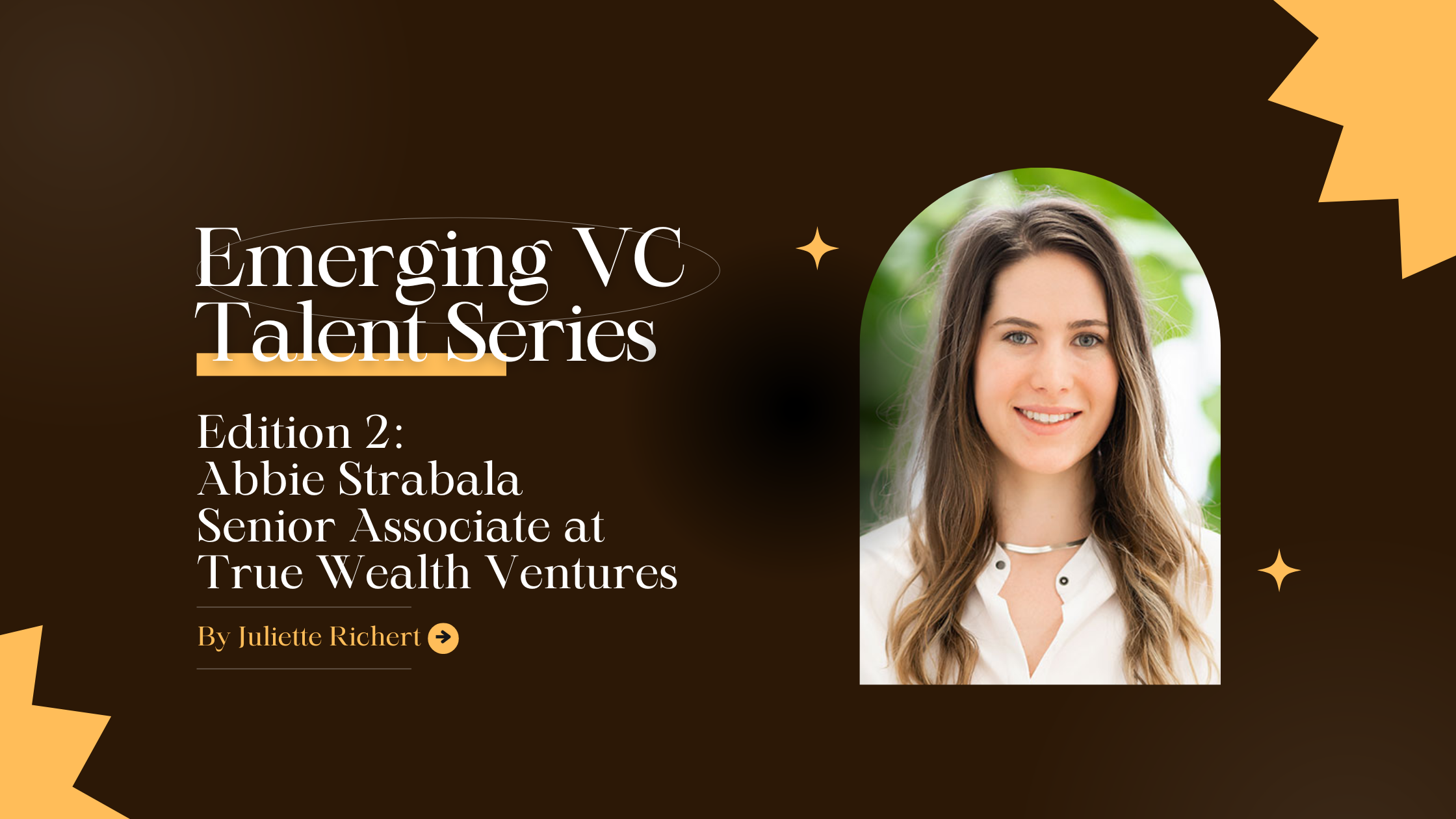
By Juliette Richert
The Artemis Fund believes technology can create prosperity for all. With offices in New York, Texas, Massachusetts, and Nevada, Artemis leads seed rounds for companies creating resilient families, individuals, and businesses across the US.
Welcome to my monthly interview series on emerging VC talent! We talk everything from gathering insights on emerging industries and tech, to venture dynamics, to career-best practices.
In the second edition, I interviewed Abbie Strabala, Senior Associate at True Wealth Ventures. True Wealth Ventures is an early-stage venture firm investing in women-led companies improving human and environmental health.
TL;DR: Key Takeaways
- Hot Take: Emerging VC talent is increasingly shaped by hands-on experience, risk-taking, and a drive for continuous learning.
- Best Practices: Networking, collaboration, and learning from others are essential for making informed decisions and achieving personal and professional growth.
- Setting Up for Success: Versatility and proactive skill development, particularly in a small team environment, are crucial for long-term success in venture capital.
- Future Outlook: The VC industry is moving towards consolidation and more selective investment strategies, especially in capital-intensive sectors like climate tech.
Get The Artemis Fund’s stories in your inbox.
Get The Artemis Fund’s stories in your inbox.
Sign up for our newsletter
Juliette: What was your first job?
Abbie: My first paid job was as an assistant for my neighbor, who was a realtor. I was around 12 or 13, and I helped with her holiday card mailings, handling about 500 letters for just $20… I was very underpaid. It taught me the value of exchanging services for money, which really hooked me. At 14, I started working in another neighbor’s store and have been working ever since. Even during career breaks, I would find ad hoc jobs. Receiving money for work is a great feeling, and I’ve been chasing that since.
Juliette: How do you spend your time outside of work? Can you speak to any professional applications or learnings?
Abbie: Since I spend so much time in front of my computer, I try to do things with my hands when I can get away. Woodworking is a big passion of mine. I started by refinishing furniture I found on the street and eventually moved on to building my own pieces. If you give me a sander, I’m gone for hours. That has really improved my ability to work on a spreadsheet or build a deck for eight hours straight.
I also bought an old motorcycle that needed fixing up and was doing mechanical work for the first time in my life. I did not want to read the directions, which is my habitual reaction to facing an unknown.
Working on these projects helps me self-reflect on my instinctual responses to any sort of problem and think more strategically about the best way to tackle challenges.
Juliette: What was the biggest skill you had to learn/up-level to excel in your role as Senior Associate?
Abbie: In my previous role, we only did follow-on investments. At that point, I didn’t fully grasp the responsibilities and role of an investor within a company. At True Wealth, we only lead deals. We invest at the seed stage, where we might be the first institutional check, and sometimes the only institutional check. That comes with a massive responsibility, not only for the governance side, but also for helping companies think strategically.
I’ve even had the opportunity to take on an operator role at one of our portfolio companies and really help them work through challenges. I’m willing to dive in without directions and learn on the fly. That’s where I thrive. I also spend a lot of time reading and listening to learn from what the best people in the industry have done. You don’t always have to reinvent the wheel.
Juliette: What are some of your negotiation best practices?
Abbie: Call a friend. Talk with other people who have been in similar situations. Gathering data points about compensation levels at other firms with a similar AUM arms you with insights to inform the conversation.
ChatGPT has also been surprisingly helpful in helping frame my thoughts and refine how I communicate them. Sometimes I just brain dump and prompt, “This is how I would say it to a friend; now how should I say it to my boss?”
Juliette: How do you learn about a new industry quickly?
Abbie: I start with a deep dive into the industry by talking to experts, reading books, listening to podcasts, and understanding customer priorities. Doing this sets a foundation where I can go back, look at the startups, and ask who’s actually solving the pain point that exists from an informed perspective, versus the pain point I think exists.
Recently, we’ve been focused on pediatric healthcare. I’ve been talking to pediatricians and healthcare providers in order to understand the industry better and hone in on the pain points. Gaining knowledge of the deeper context helps me understand what is driving decision makers, which ultimately defines how we think about the contracts and customers that startups are going after.
To source industry experts, we are on Linkedin a lot. We’ll also look at our LPs. In this case, we have one or two pediatricians that are LPs in our fund, so we’ll call on them. If I’m really struggling, there are different networks I’ll tap into. Facebook groups are surprisingly really popular with providers. Sometimes you have to scrape it together to gather the knowledge you need.
Juliette: Talk to me about the challenges of being on a small team.
Abbie: My first six months at True Wealth were rough, because I went from being in an office with a team — there were three of us at the pre-partner level — to being alone in San Francisco with no colleagues and just two bosses.
To balance it out, I joined a co-working space to have a place to go with other people. It has been amazing because I’ve met so many other investors who are in similar boats. They’re out here in San Francisco on their own too, so we formed a cohort of sorts. It gives us the opportunity to chat about various things we’re working on and get feedback from others in real time.
Other people who are at similar levels at firms with a similar thesis are likely going through similar things. Connecting with them helps you get different points of feedback.
It genuinely helps to just be able to jump on a call with somebody and say, “This is what’s happening. Have you been in this situation before? How did you navigate it?”
Juliette: Talk to me about the benefits of being on a small team.
Abbie: One reason I love working on these super small teams is that you get exposure to everything, and you have the flexibility to expand on any gaps in your skillset. For example, if improving cap table analysis and financial modeling is the goal, you can commit to handling all cap table analysis for a year to strengthen that skill. For anyone working on flexing that particular muscle, I took a great financial modeling course by Zach Brunner that I highly recommend.
The partners at my fund have also always been incredibly supportive. They give me a lot of responsibility and trust that I will come find help when I need it. They’ve done an amazing job of trusting me, letting me own my work, and giving me support when I need it. That’s really given me the confidence to dive into any challenge.
Juliette: Where do you see your career heading in the next five years, and what’s the next level up you see for yourself to reach that harder decision-making spot?
Abbie: I am deeply committed to the venture capital industry for the long haul. My next goal is potentially raising another fund or starting my own. I am working to be the decision-maker and setting the investment strategy.
To get there, I’m flexing my decision-making muscles. Angel investing forces me to do that and helps me understand how my decision-making changes when it’s solely my decision and my money. I write small, $1K checks into pre-seed companies. I’m getting to play around with my long term thesis and build tactical skills. I’ve made three investments, writing working theses and building construction models for each. I’ve committed myself to investing $20K over two and a half years.
Juliette: Where do you see the VC/PE industry going?
Abbie: I anticipate massive consolidation in the industry over the next few years. Many small funds may not survive, leading to mergers or firms fizzling out. This might be good for the industry as it encourages more selective and strategic investments. Venture capital will remain a key driver of innovation in the U.S., but investors need to be more discerning about what types of businesses are suited for VC funding versus other forms of capital.
Juliette: What’s the first company you fell in love with?
Abbie: The first company I really championed was Fluus, a UK-based company that makes biodegradable and flushable menstrual pads. I’m passionate about sustainability and healthcare, so this was a perfect fit. In the True Wealth portfolio, I’m also very excited about Partum, a company focused on maternal healthcare. I led their seed round because I believed in the solution so strongly.
Juliette: Tell me about someone you look up to outside of the VC industry.
Abbie: My parents. They got divorced a few years ago and have been on a self-discovery journey ever since. Watching them rediscover themselves as adults has been incredibly inspiring. It’s been really cool to see them grow and change in their 60s.
Juliette: Biggest learning or piece of advice?
Abbie: Don’t give advice, share experiences.
We believe once in a generation companies will be built by unexpected founders. If that sounds like you, pitch us here!

Newsletter Signup
