

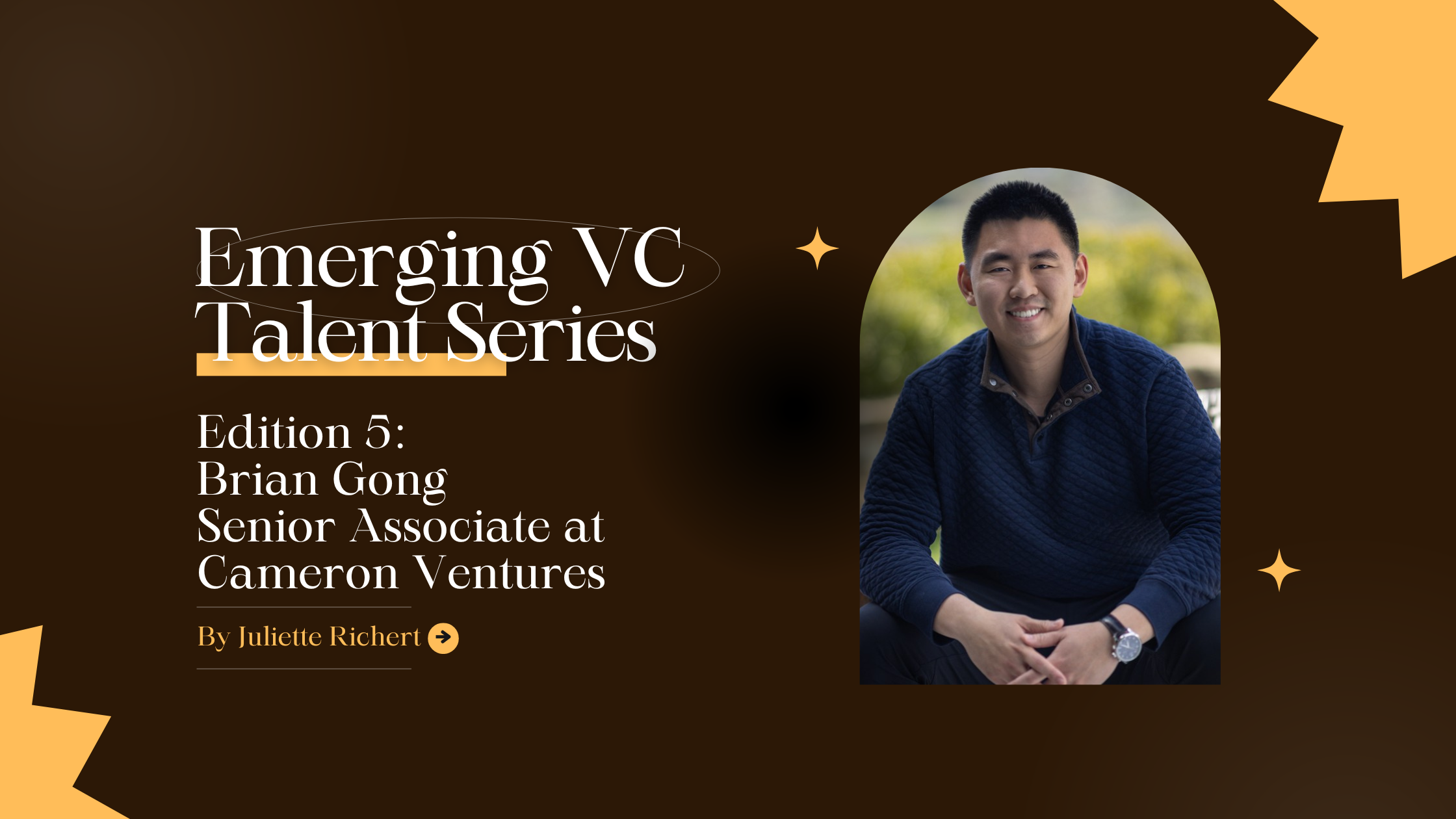
Emerging VC Talent: Edition 5, Brian Gong
November 21, 2024
By Juliette Richert
The Artemis Fund believes technology can create prosperity for all. With offices in New York, Texas, Massachusetts, and Nevada, Artemis leads seed rounds for companies creating resilient families, individuals, and businesses across the US.
Welcome to my monthly interview series on emerging VC talent! We talk everything from gathering insights on emerging industries and tech, to venture dynamics, to career-best practices.
In the fifth edition, I interviewed Brian Gong, Senior Associate at Cameron Ventures. Cameron Ventures is an early-stage venture fund with affiliate operating companies that serve customers across the United States, primarily in insurance, banking and asset management.
TL;DR: Key Takeaways
- Hot Take: Technologies like AI are changing how consumer medical, marketing, and other sectors operate, allowing companies to offer free services while monetizing in innovative ways. The ability to adapt quickly to these shifts will define the next generation of successful VC-backed companies.
- Best Practices: Maintain a flexible mindset when evaluating founders and markets. Go beyond surface-level assessments by challenging your own biases and considering diverse perspectives.
- Setting Up for Success: Continuously refine your perspective by gathering insights from founders and industry experts.
- Future Outlook: Expect a bifurcation in the VC industry, with larger funds going public and smaller funds becoming more specialized.
Get The Artemis Fund’s stories in your inbox.
Get The Artemis Fund’s stories in your inbox.
Sign up for our newsletter
Juliette: What was your first job?
Brian: When I was 17, I was a camp counselor for 4–6 year olds, managing 20 toddlers running around. The clientele were the kids of wealthy families on Long Island. Having a 10-year age gap with my sister meant I already knew how to change diapers by the time I started this job. I made $1,500 for the summer, so it was pretty good pay at that age. That being said, I did have a moment while hosing off a child after an accident where I thought, “I’m not getting paid enough for this.”
In a way, being a VC is like being a camp counselor — herding everyone’s attention to the same goal and gathering opinions.
Juliette: How do you spend your time outside of work? Can you speak to any professional applications or learnings?
Brian: I’m currently training for my fifth marathon, running Philly this year after completing New York last year. My life is a lot of running, sleeping, and eating. I like to listen to podcasts while I run, and I’ve been especially into The Logan Bartlett Show recently. Running also clears my head — when I’m considering a new company or theme, it helps me intellectually spar with myself and let ideas work themselves out in the background.
Juliette: How do you disregard what you’ve learned in an era where new technologies are breaking the status quo?
Brian: It’s important to rethink the companies and categories we invest in, especially with technology shifting the landscape. For example, scaling a consumer medical or patient advocacy business used to be incredibly difficult — you had to partner with carriers or charge subscriptions. With AI, you can do that at scale and offer it for free, with revenue coming from different sources, like payment flow or interchange. This type of technological shift is enabling new business models. How the world evolves and what the economy looks like will impact consumer solutions in particular, which is why we’ve been measured in our approach to deploying capital at Cameron Ventures.
Medbill is a great example. In their case, they’re making money on the payment flow and the interchange after the negotiation is complete. It’s enabling a new business model that can be accomplished with new technology vs. manual integration work from the past. It’s a step change. How the world evolves and what the economy looks like will impact consumer solutions in particular, which is why we’ve been measured in our approach to deploying capital.
Juliette: Is there a theme or trend you’re tracking within the broader scope of AI?
Brian: I’m closely following developments in AdTech and MarTech, particularly how SEO will evolve for industries like insurance. Right now, we use Google, but in the future, LLMs will drive search. The key question is, how will your brand surface in those queries? I’m thinking about how this shift will impact insurance and the need to integrate data science into marketing strategies.
Juliette: How do you learn about a new industry quickly?
Brian: When it comes to consumer products, I think about how my own life intersects. We do a lot of enterprise investing too, so I put myself in the shoes of the enterprise decision maker. We’ll tap our enterprise decision makers at our operating companies to gain their perspective. We can step into their shoes across the entire customer set, plus, we can think about partnerships and reap the benefits of using their technology earlier.
Juliette: Where do you see the VC/PE industry going?
Brian: I see a bifurcation in who backs what. We’ll likely see several $5-$10B AUM funds going public, almost like an index of top private companies in each sector. Meanwhile, smaller funds will remain deeply embedded in specific industries, with better agility to anticipate market shifts. Competition is going to increase, and funds will be forced to go earlier and compete with larger players. I also think a lot of funds will get washed out over the next few years.
Juliette: What was the biggest skill you had to learn/up-level to excel in your role as Senior Associate?
Brian: I’m still learning and improving, but I’ve been spending more time with founders — helping with fundraising and building B2B partnerships and relationships. I’m tuning my filter to see what founders see in markets vs. what VCs see in markets. Founders focus on overcoming challenges to compete, while VCs are evaluating market opportunities. Founders think about markets in the way that they experience them. By having an opinion in the first place, you can help yourself develop a new perspective and allay your own confirmation bias.
Juliette: What’s the first company you fell in love with?
Brian: I interned at Wayfair during my junior year of college, and it was my first real exposure to the startup world. Working there showed me what a larger enterprise or Series D+ business could look like, and I realized that work could be both enjoyable and collaborative. The culture was incredible — they emphasized internal affinity groups like hiking and card-playing, and people would hang out after work. It really sparked my interest in startups and left a lasting impression on me.
Juliette: Biggest learning or piece of advice?
Brian: Never judge a book by its cover. We tend to gravitate towards people who remind us of ourselves, which is why there’s a lack of diversity in venture. I try to step outside of my own biases and really understand the experiences of the founders I’m speaking with. It’s crucial to look at the whole picture, beyond just the model or idea. I prefer early-stage venture because it’s more focused on people — finding great founders rather than just great businesses.
We believe once in a generation companies will be built by unexpected founders. If that sounds like you, pitch us here!

Newsletter Signup
