

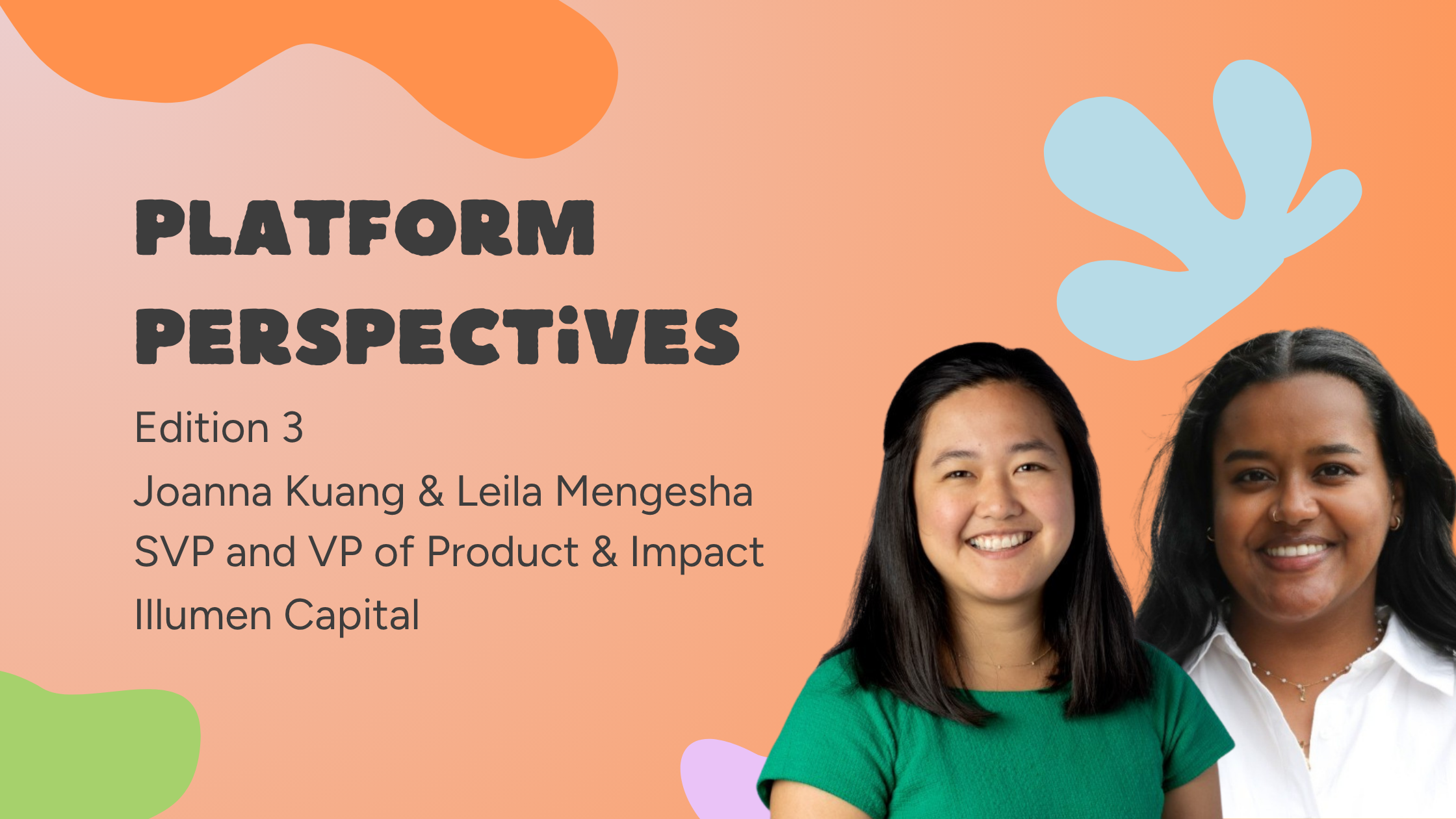
Platform Perspectives, Edition 3: Joanna Kuang & Leila Mengesha
September 26, 2025
By Rachel Mackey
The Artemis Fund believes technology can create prosperity for all. With offices in New York, Texas, Massachusetts, and Nevada, Artemis leads seed rounds for companies creating resilient families, individuals, and businesses across the US.
This edition of Platform Perspectives features a conversation with Joanna Kuang and Leila Mengesha of Illumen Capital, a fund of funds investing in managers across venture capital, growth equity, and private equity with the goal of reducing bias across the capital markets.
Joanna and Leila lead platform and impact strategy at Illumen, building out a deeply resourced, high-touch approach that supports both GPs and LPs in reducing biases in their operations and investments. We talked about what LP platform looks like in practice, how they’re navigating the role of AI in bias reduction, and the value of relational capital in a tough fundraising market.
Get The Artemis Fund’s stories in your inbox.
Get The Artemis Fund’s stories in your inbox.
Sign up for our newsletter
Rachel: Joanna, let’s start with your path into institutional investing. What led you to this work?
Joanna: I first became interested in impact investing after spending a summer teaching in the Mississippi Delta at a Freedom School called the Sunflower County Freedom Project. I saw how transformational the program was, but also how disconnected and limited funding sources were from what was actually needed, things like food and transportation, not just academic supplies. That summer really opened my eyes to the gaps between capital and community. I realized I wanted to spend my career bridging that gap.
From there, I worked at Wellington Management, then explored outcomes-based funding models at a nonprofit. For the last five years at Illumen, I’ve been building a platform that not only supports our GPs, but also works with our LPs to reduce bias in how capital flows. That dual influence is pretty unique.
Rachel: How do you define platform at Illumen? What does your work look like day to day?
Leila: Platform here means building resources that extend far beyond capital. We’re incredibly high-touch LPs, sometimes the most active on a cap table. Our thesis is rooted in reducing racial and gender bias to create a more optimal asset management industry, and we bring that lens to everything we do.
This means creating peer learning opportunities for our portfolio fund managers, 1:1 bias reduction coaching, and developing new tools for IllumenIQ®, our proprietary resource hub that houses primers, how tos, and frameworks for embedding equity across firm operations. Platform is something our whole firm takes seriously, from our operations team hosting best practice calls, to our IR team creating visibility for managers in the broader ecosystem.
Rachel: Can you talk to me about how you’re using AI, or thinking about its role?
Joanna: We use AI to scan for relevant research that informs our tools, especially within IllumenIQ®. That includes surfacing case studies, academic papers, or emerging practices that can help fund managers operationalize bias reduction.
We’re also curating case studies from our own community, like how one fund uses AI to apply consistent scorecards at the top of their funnel. It’s a powerful way to reduce bias in how deals are evaluated, but it only works if there’s a human in the loop.
Leila: Bias reduction requires adding friction. AI tools are designed for speed, and that can be at odds with intentional decision-making. So we’ve added guidance around AI usage to IllumenIQ® as well: reflective prompts, red flags, and reminders that these tools are learning from us, and we’re not bias-free.
Rachel: What’s a recent initiative you’re proud of?
Joanna: We’re proud of how we’ve built community. Our platform runs on relationships: between us and our managers, and between managers themselves. We’ve hosted topical webinars, town halls, and even a film screening to bring our GPs and LPs together in support of fundraising, learning, and storytelling.
We also take a cohort-based approach to manager support. That’s allowed some of our more established managers to serve as mentors for first-time fund managers, which helps address the drop-off we sometimes see with emerging managers in the industry between their Fund I and Fund II.
Leila: We also launched a direct investing program through our Catalyst Fund. It allows us to co-invest in companies alongside the fund managers in our portfolio. It’s deepening our engagement and giving us more insight into impact at the company level, from board diversity to outcomes metrics. It’s still early, but the learning is invaluable.
Rachel: How do you choose fund managers? What does diligence look like?
Joanna: Our diligence is a cross-functional process. Our investment team leads top-of-funnel sourcing, but once a manager advances to full diligence, platform and operations also get involved. I evaluate alignment on bias reduction and impact strategy, and our ops lead dives into compliance and financial infrastructure. It’s a holistic view.
We also use a pre-diligence questionnaire. It’s one of the ways we reduce reliance on warm intros. That form asks about everything from operational readiness to firm values and bias training, and helps level the playing field before we even meet with a manager.
We’re not just looking for where a manager is today. We’re looking for their willingness to grow. We’ve worked with funds on everything from succession planning to partnering with leadership coaches. We want to help make equity part of the infrastructure, not just an individual value.
Rachel: What do your direct investments look like?
Leila: Most of our direct investments are in venture-stage companies, though we also work with some growth-stage opportunities. We’re looking for three things: a founder with lived experience or a values-aligned mission, strong financial performance, and clear alignment with one of our five impact themes.
The Catalyst Fund lets us go deeper on impact reporting too. We can ask questions like can this company share outcomes data? It’s been a really helpful way to complement our fund-level strategy.
Rachel: What advice would you give to someone looking to break into platform?
Joanna: Be the opposite of a gatekeeper. Platform is about generosity of time, networks, and ideas. You don’t have to be an extrovert, but you do need to care deeply about the people you support. And have a point of view. Know what you stand for and what kind of community you want to build.
Leila: I’d add: start with mission. So much of platform is demonstrating care for the community you’re developing. If you believe in what the fund is doing, you’ll be more effective at building helpful resources and relationships. Hubs for mission aligned folks like Impact Capital Managers or Substack interviews like this one are great for understanding who’s out there and what they’re hiring for.
Rachel: What excites you most about this work?
Leila: No two days look the same. Because we invest across asset classes and impact pillars, there’s so much space to experiment. We’ve piloted new programs, hosted convenings, even helped non-impact funds take their first steps toward tracking metrics. The trust we’ve built with our managers allows us to innovate, and that keeps things exciting.
Joanna: It’s that trust for me too — especially when market enthusiasm for impact ebbs and flows, it’s our relationships that allow us to keep doing this work. We’re helping change happen quietly and persistently, which can be just as powerful as headlines.

Newsletter Signup
