

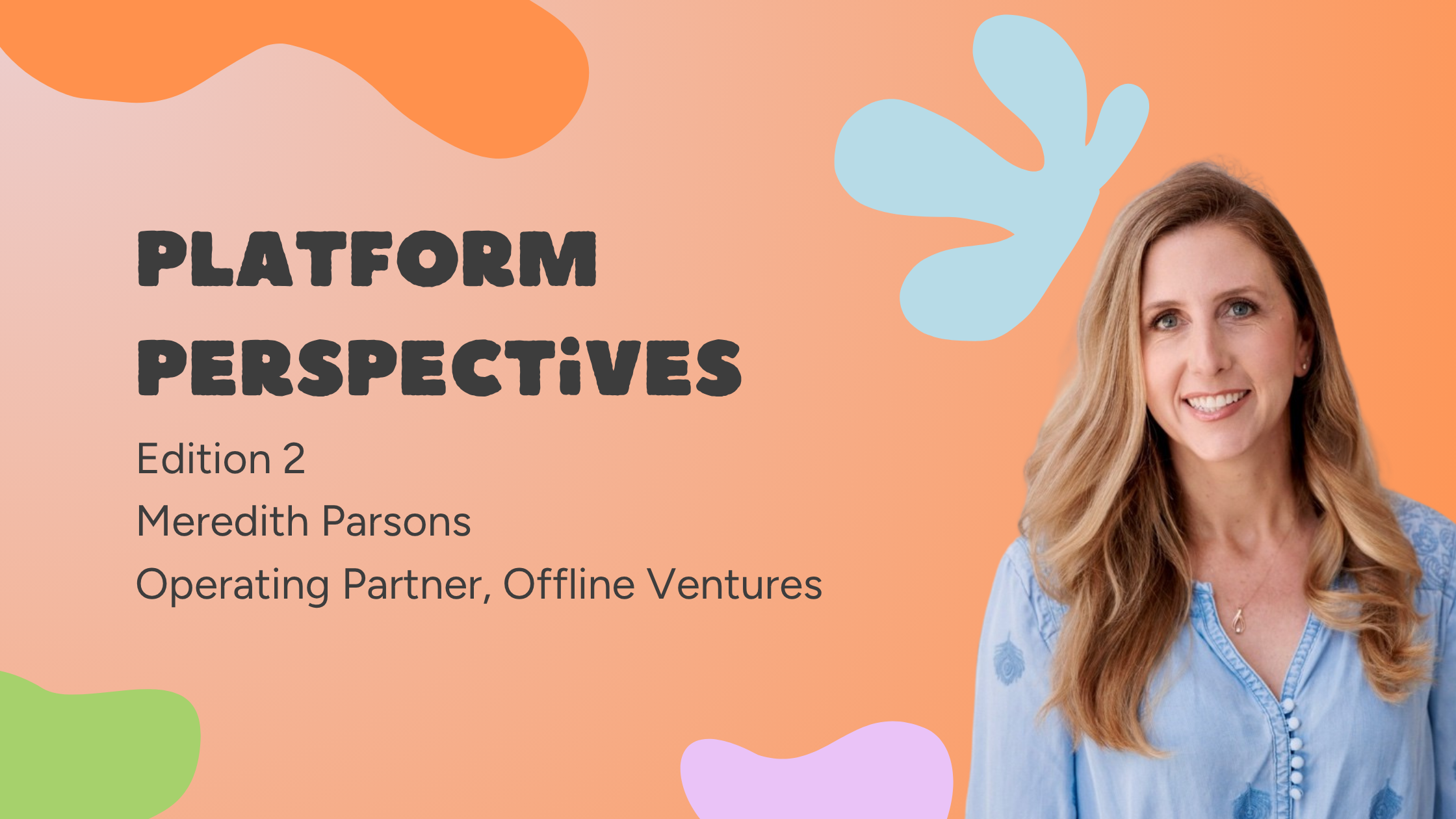
Platform Perspectives, Edition 2: Meredith Parsons
July 21, 2025
By Rachel Mackey
The Artemis Fund believes technology can create prosperity for all. With offices in New York, Texas, Massachusetts, and Nevada, Artemis leads seed rounds for companies creating resilient families, individuals, and businesses across the US.
In my monthly series, I interview VC platform professionals to learn: how they got to where they are today, what platform means to them, and where they think the future of platform is headed.
For the second edition, I interviewed Meredith Parsons, Operating Partner at Offline Ventures. Offline Ventures is an early-stage venture fund and studio in pursuit of a world where technology lives in harmony with humanity.
Get The Artemis Fund’s stories in your inbox.
Get The Artemis Fund’s stories in your inbox.
Sign up for our newsletter
Rachel: How did you get into venture?
Meredith: Pretty randomly. I was living in Denver and wanted to move back to the Bay where I grew up. A childhood friend at DFJ was rotating out of her role and said, “You’d be good here.” I had no finance background, just a master’s in education and a nonprofit career, but I clicked with the team, they took a chance on me, and I figured it out as I went.
Rachel: How has your background in education and nonprofits been relevant in venture?
Meredith: It’s more transferable than you’d think. Classroom management is solid prep for stakeholder management. Scaffolding learning maps well to building systems. And nonprofits taught me how to be scrappy with budget and resources, skills that come in handy every day in venture ops.
Rachel: What early-career experiences helped you transition into your current platform and ops role?
Meredith: I spent a few years as a legal secretary and corporate paralegal. I got fluent in detail and process. Later, I ran national coaching and international team programs at USA Ultimate with a limited budget and a nationwide network of volunteers. That taught me how to build a structure without reliable headcount. Both shaped how I operate today: lean teams, structured execution, and no fear of complexity.
Rachel: Can you talk to me about what your role looks like at Offline Ventures?
Meredith: I focus primarily on internal operations, including legal, portfolio management, LP relations, tooling, systems, and whatever else needs unblocking. I love the mechanics of firm-building and seeing a system run cleanly end to end. But I also get to know founders early, as we work through legal docs and funding, and stay connected through check-ins and future rounds. That mix of firm operations and building real founder relationships is what fills my bucket.
Rachel: What was your path to becoming a partner?
Meredith: I earned trust by consistently raising my hand for the ambiguous, messy, unclaimed work, the kind no one owns but everyone depends on. I started in venture in 2014, and over time, that meant building context across every corner of the firm. I think of it like assembling a mosaic: each odd-shaped project, from fund ops to founder support, adds another tile. Eventually, I had enough pieces and perspective to see the full picture of how a modern venture fund should run. That earned me the partner title, but the work came first.
Rachel: What’s your current thinking around how platform and ops roles are evolving?
Meredith: We’re moving from reactive executors to strategic operators. Earlier in my career, I’d outwork problems, stay late, and muscle through. Now I try to out-system them. Platform roles are becoming more productized, characterized by repeatability, scalability, and a closer alignment with the core of how firms create value. It’s not “support.” It’s infrastructure.
What’s shifting now is signal. Platform sits at the center of where operational data flows: updates, tools, workflows, founder feedback. The next evolution is turning that firehose into strategy: surfacing patterns, spotting gaps, building repeatable responses. That’s where AI comes in, by compounding firm intelligence. Platform becomes the connective tissue that enables a venture firm to think faster, act smarter, and scale trust.
Rachel: What are some ways you’re using AI in your work?
Meredith: I’ve trained a GPT on a filtered email label to summarize the key updates I share with my team on a weekly basis. I use Zapier to pipe Slack content into Google Docs, allowing a GPT to stitch together context across platforms. For meetings (where I have permission), I use Quill for transcripts and run those through ChatGPT to get sharper, more relevant outputs. I also trained GPT on my email tone so it drafts like me with minimal editing.
None of it’s rocket science. Just small, compounding hacks that speed up my output. My rule of thumb: prioritize clean input, stay relatively tool-agnostic. The space is evolving too fast to bet on any one stack.
Rachel: How do you think AI will reshape platform roles?
Meredith: It’ll make platform more anticipatory. With better data and faster signal processing, we’ll be able to spot founder needs before they surface, not just respond, but predict. That shift makes platform even more central to how firms operate.
Over time, I see platform evolving into a true product function focused on building systems that scale firm intelligence. As AI changes how deals are sourced and supported, firms will realize that a goal of picking winners isn’t enough. You need internal teams that can build infrastructure to compete. Investors may place the bets, but platform makes the machine run.
Rachel: What concerns do you have about AI adoption?
Meredith: Apprenticeship is the big one. VC is still an apprenticeship-based business, and judgment gets built through repetition and pattern matching. If AI takes over early-stage analytical work, where do future investors develop that muscle? Same risk in other industries too. Skip the foundation, and the whole thing wobbles later.
Rachel: Any advice for someone trying to break into platform or ops in VC?
Meredith: It’s not easy. Relationships matter more than résumés. It’s a small industry, and trust moves faster than credentials. Volunteering with orgs like All Raise can help. EIR roles are also a good wedge in, especially if you’re coming from product. But you have to be ready to raise your hand for anything and prove you can learn fast.

Newsletter Signup
