

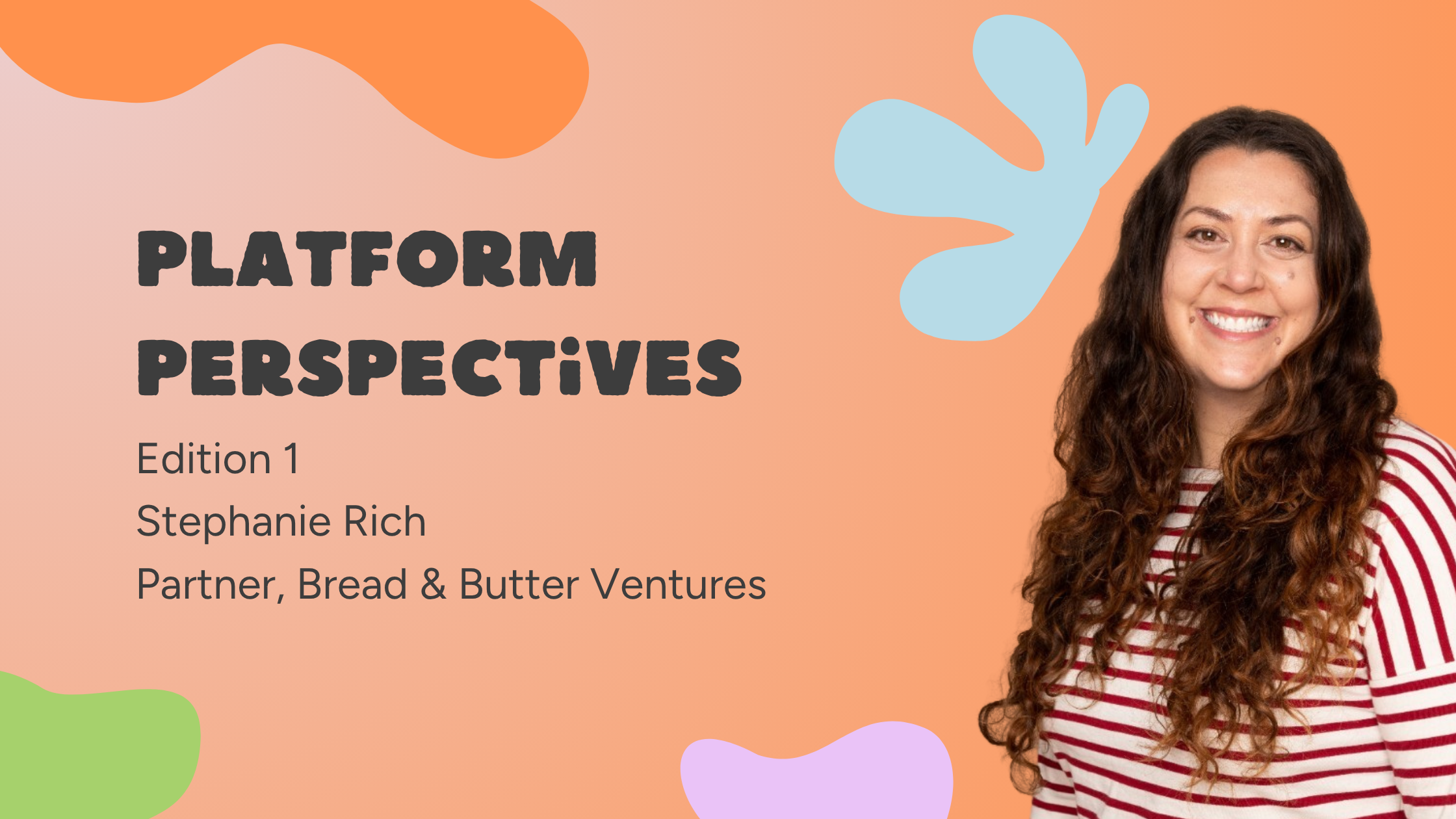
Platform Perspectives: Edition 1, Stephanie Rich
June 10, 2025
By Rachel Mackey
The Artemis Fund believes technology can create prosperity for all. With offices in New York, Texas, Massachusetts, and Nevada, Artemis leads seed rounds for companies creating resilient families, individuals, and businesses across the US.
In my monthly series, I interview VC platform professionals to learn: how they got to where they are today, what platform means to them, and where they think the future of platform is headed.
For the inaugural edition, I interviewed Stephanie Rich, Partner at Bread & Butter Ventures. Bread & Butter Ventures is a seed stage venture fund based in Minnesota, backing companies innovating in food & ag tech, Healthtech, and Enterprise SaaS.
Get The Artemis Fund’s stories in your inbox.
Get The Artemis Fund’s stories in your inbox.
Sign up for our newsletter
Rachel: How did you first get into venture?
Stephanie: I accidentally became employee number one at a startup coming out of business school. It wasn’t venture-backed when I joined, but it eventually was. That experience was foundational, and I got to do a bit of everything: customer success, HR, marketing. I made all the mistakes, but I learned fast.
While still at that startup, I started mentoring early-stage founders and became a Techstars mentor in 2016. By 2019, I was Entrepreneur in Residence at Techstars Farm to Fork, where I worked with a solo GP named Brett Brohl. When I decided to move on from my own startup, Brett and Mary (Grove) invited me to join Bread & Butter full-time as Head of Platform. I said yes, without actually knowing what “platform” meant. That was over five years ago.
Rachel: How do you think your early career experience helped you succeed in a platform role?
Stephanie: In journalism school, I learned how to tell stories, interview people, ask thoughtful questions, and go deep on unfamiliar topics. I think this helped me with connecting dots and people, which is core to platform work. Those skills are also incredibly relevant when your portfolio includes everything from supply chain SaaS to digital health.
Context switching has also been key, as in having the ability to jump from a pitch deck to an event plan to building a new tool. In addition, I think having real operating experience early in my career has helped me be empathetic with founders, because I’ve been in their shoes.
I’ve always believed that if you show up and deliver in the role you’re in, it opens the door to what’s next. I was recently promoted to Partner, and it meant a lot that Brett and Mary placed their trust in me. That vote of confidence came from years of doing the work, and learning how to keep leveling up as the job evolved.
Rachel: What does your role look like day-to-day?
Stephanie: I divide it into four buckets and three pillars:
Buckets:
- Marketing, brand, and comms for the firm
- Running our Innovation Circle (corporate partner community in Minnesota)
- One-on-one support for founders
- Building scalable tools and networks to support multiple companies at once
Pillars within that work:
- Fundraising
- Business development/sales
- PR/marketing
I spend a lot of time thinking about how to build support that scales.
Rachel: Let’s talk about AI. How are you using it?
Stephanie: Content is a big area: LinkedIn posts, newsletters, founder updates. I start with an outline I generated, run it through AI, then edit again. It’s a “human sandwich”, a term I didn’t coin, but is a perfect descriptor. AI just really helps with clarity and speed, especially when you’re a solo operator.
A few other tools I’m using are:
- Gamma for designing decks
- Softr for rebuilding our founder portal
- Glide for our fundraising app
- Create (via vibe coding) for a new public-facing app I’m working on
- And of course, ChatGPT for visuals and copy
Most recently, I used ChatGPT to generate brand-aligned sketches for our founder portal. It’s all about small efficiencies that add up.
Rachel: More and more VCs are building their brands on Linkedin. Is it worth the effort?
Stephanie: I think so. Even if engagement feels lower, people do read what you post. I constantly get in-person comments about posts I assumed no one saw.
It’s also about first impressions: journalists, VCs, LPs, and founders will look you up. Having a polished, authentic profile and posting with regularity matters.
Rachel: What’s one project you’re especially excited about right now?
Stephanie: Our completely revamped founder portal on Softr. It’s beautiful, more functional, and designed to scale. I used AI heavily in this project, from layout visuals to perks management.
I’m also already thinking about our 2026 Founder Summit. We only host it every other year, and we ask our founders to fly to Minnesota, so it has to be phenomenal.
Rachel: Where do you think the future of platform is headed?
Stephanie: We’ll see more technical and data-focused talent in platform roles, either hired in-house or built via consultancy. I also think we’ll continue to see specialization, but there will always be space for strong generalists who can own the platform function and hire or contract the specialists as needed.
It also really depends on fund size, some can support a full team, others need one person to wear all the hats.
Rachel: What’s your best advice for someone trying to get into platform?
Stephanie: Be genuinely helpful. Pick an area (events, ops, content, etc), learn enough to add real value, and do your research. Make sure your values are aligned with the firm’s values and the GPs’. I’m incredibly lucky to work with two GPs I admire deeply. That trust gives me the freedom to experiment and make meaningful things happen.

Newsletter Signup
