

Q1 2026 VC Market Update
May 28, 2026

By The Artemis Fund
The Artemis Fund believes technology can create prosperity for all. With offices in New York, Texas, Massachusetts, and Nevada, Artemis leads seed rounds for companies creating resilient families, individuals, and businesses across the US.
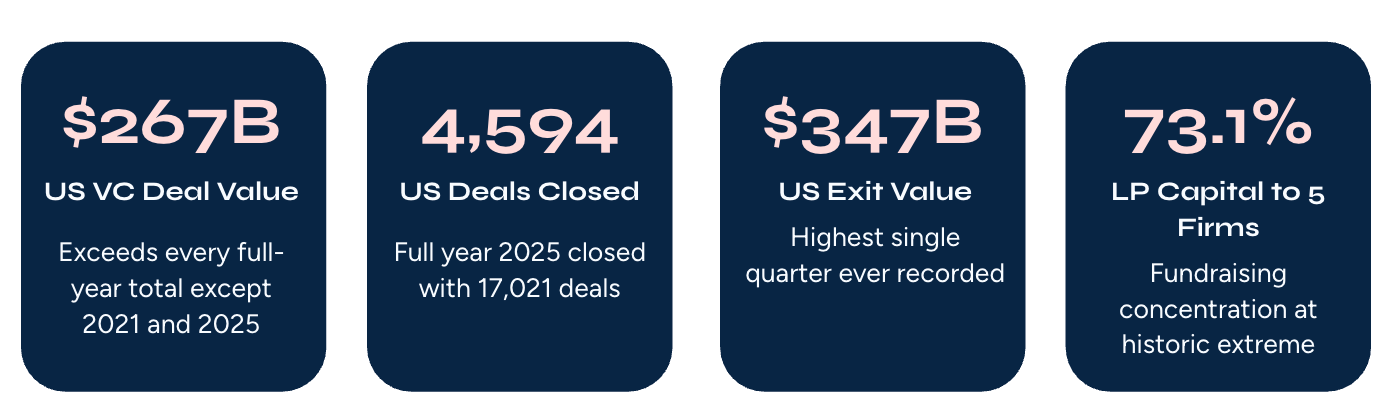
Q1 2026 was a record quarter for US venture capital by almost every headline measure. The $267.2 billion in US deal value exceeded every full-year total on record except 2021 and 2025. Exit value hit $347.3 billion, also the highest quarter ever. But both numbers are almost entirely a story about a handful of companies, and the market beneath those outliers looks much the same as it has for the past three years.
Get The Artemis Fund’s stories in your inbox.
Get The Artemis Fund’s stories in your inbox.
Sign up for our newsletter
Global context: Global VC hit an all-time quarterly record of ~$300B in Q1 2026, up over 150% YoY driven by four US-headquartered companies that collectively raised $188B. The US captured approximately 83% of global venture dollars in the quarter. All figures below reflect the US market unless otherwise noted.
What Happened in Q1 2026
What Happened in Q1 2026
Q1 2026 was a record quarter for US venture capital by almost every headline measure. The $267.2 billion in US deal value exceeded every full-year total on record except 2021 and 2025. Exit value hit $347.3 billion, also the highest quarter ever. But both numbers are almost entirely a story about a handful of companies, and the market beneath those outliers looks much the same as it has for the past three years.
The Deals That Defined the Quarter
The Deals That Defined the Quarter
Five companies captured $195.6 billion in investment, representing roughly 73% of all US VC deal value in Q1:
- OpenAI raised $122 billion, accounting for 43% of all US VC funding alone
- Anthropic raised $30 billion
- xAI raised $20 billion
- Waymo raised $16 billion
- Databricks raised $7 billion
Excluding the five largest deals, total US deal value falls by 73.2%. This level of concentration is without precedent in modern venture history.
Source: PitchBook-NVCA Venture Monitor, Q1 2026
Valuations Are Rising Across Every Stage
Valuations Are Rising Across Every Stage
Even setting aside outlier rounds, valuations have climbed significantly across the full US venture stack:
- Median seed pre-money valuation: $18.4 million, more than double the 2021 figure
- Median Series A pre-money valuation: $62 million, nearly triple the $21 million recorded in 2020; median deal size rose to $19.6 million from $7.5 million over the same period
- Median Series C pre-money valuation: $579 million, up from $167.2 million in 2020; median deal size expanded to $75 million from $35 million
- Half of all early-stage deals now exceed $10 million, the highest share in a decade
The gap between median and average deal sizes is telling: at Series A, the median of $19.6 million sits well below the average of $39.6 million. At Series C, the $75 million median sits well below the $124.6 million average. The divergence reflects a bifurcated market where a small number of companies are vastly outraising the rest.
Source: PitchBook-NVCA Venture Monitor, Q1 2026
Early Stage: Volume Up, But Driven by a Few Firms
Early Stage: Volume Up, But Driven by a Few Firms
In the U.S., deal counts have ticked up at the early stage over the past four quarters, largely due to two forces: aging dry powder creating deployment pressure, and a small set of leading firms accelerating seed activity. In Q1, Andreessen Horowitz and Y Combinator each made 46 investments, General Catalyst made 25, and Sequoia made 22.
Globally, seed funding totaled $12 billion in Q1, up 31% year over year, but the increase was entirely driven by larger rounds, with deal counts actually falling 30% year over year. Early-stage funding (Series A and B) totaled $41.3 billion across 1,800 deals globally, up 41% year over year, with most of the growth going to Series A.
The Exit Picture
The Exit Picture
US exit value hit $347.3 billion in Q1, the highest quarter ever recorded. As with investment, the numbers are almost entirely explained by a few transactions.
- SpaceX's acquisition of xAI for $250 billion was the largest VC-backed exit of a US company ever; combined with the Wiz exit, just two deals represented 81.2% of total Q1 exit value
- Excluding the three largest exits, the remainder generated $93.1 billion, still a strong result that exceeds the full-year 2024 exit total on its own
- AI M&A reached 266 deals in Q1, near its quarterly record; AI IPOs hit a record 21
- Despite the headline numbers, IPO registrations have not moved significantly
Q1 was a story of strategic mega-deals at the top, not a reopening of exit channels across the market.
Source: PitchBook, May 2026
The looming potential: IPOs from SpaceX, OpenAI, Anthropic, Databricks, and Stripe could collectively generate nearly $2.5 trillion in exit value, more than all VC-backed IPOs this century combined. The question is whether those listings create energy for a broader wave, or absorb all available capital and attention while the backlog of SaaS and AI application companies keeps waiting.
Secondaries: The New Liquidity Layer
Secondaries: The New Liquidity Layer
With the traditional exit window still selective, secondaries are increasingly becoming the primary mechanism for returning capital to LPs.
- Q1 2026 saw 134 secondary deals, putting the full year on pace for 536 transactions, equaling the 2025 annual record
- Stripe ran structured secondary programs at a $159 billion valuation in February 2026
- Anthropic paired its $30 billion primary raise with a shareholder sell-down, allowing early backers to take money off the table while the company remains private
Private companies are increasingly raising capital, distributing it, and staying private on their own terms. The traditional exit-driven venture model is giving way to something more continuous, and the regulatory environment is beginning to catch up.
Source: CB Insights, State of Venture Q1 2026
Fragility Beneath the Surface
Fragility Beneath the Surface
The concentration that defines this market also introduces a structural risk that did not exist in the 2021 bull market.
Any single deal slipping or repricing can swing the entire market narrative from record-breaking to disappointing overnight. This was not the case in 2021, when activity was broad-based.
Source: PitchBook, May 2026
Additional signals of underlying fragility in the US market:
- Fewer deals, larger checks: Q1 2026 saw approximately 4,594 reported US deals, a figure PitchBook expects to be revised upward as lagged deal reporting catches up. For context, full-year 2025 closed with 17,021 deals
- Fund concentration is extreme: 73.1% of all LP capital raised in Q1 went to just five VC firms; the next ten firms combined captured 15.4%; all remaining firms split 11.5%
- Emerging managers are struggling to raise: More funds over $1 billion closed in Q1 2026 than during all of 2025; smaller vehicles and first-time managers face a very difficult fundraising environment
- Fund returns remain weak: The median VC IRR for North American fund vintages since 2019 sits in the single digits; the median distributions-to-paid-in multiple for vintages over the past decade remains below 1x
- The unicorn backlog is growing: The aggregate post-money valuation of unicorns has crossed $5.8 trillion; 44.6% of those unicorns had their first VC round in 2016 or earlier, meaning early investors and employees at nearly half of all unicorns have been waiting more than a decade for liquidity, prompting the rise of secondaries.
- Rate cuts are off the table: Wall Street is currently pricing in zero rate cuts for the rest of 2026, removing a key catalyst that was expected to boost risk appetite and IPO demand
What This Means for Artemis
What This Means for Artemis
The concentration into AI hyperscalers is driving uncertainty and potential risk across the market. The capital flooding into OpenAI, Anthropic, xAI, and Databricks is a bet on who builds the foundation of a new AI powered economy. We believe the future of work and human productivity will drastically change. We are investing in the companies building the future of the way we build wealth and care for our families, powered by AI.
We are leaning into the future of how businesses launch, finance, and scale. AI will revolutionize the amount of products and platforms available, good and bad. Agentic fintech and commerce will create lightning fast and lower cost money movement, lots of choice, and more fraud. We expect an abundance of new products, services, and problems. Artemis is backing the founders building trust infrastructure that makes faster money movement safe, and the tools that make businesses more nimble in how they operate and scale.
One area where we see an extraordinary opportunity is healthcare. AI will soon allow specialists to treat multiples more patients in places they have never been able to serve, and without burnout. Care is a $600B problem, and healthcare represents 18% of the US GDP. Access is constrained by provider shortages, waste, and inefficiencies. These factors have driven the cost of care to unprecedented and unsustainable levels. We are backing the founders building the future of care as an accessible, data driven, patient led, and affordable system.
Across fintech, commerce, and care, we are backing founders building what AI cannot replicate: domain expertise, distribution insight, community trust, and category understanding built over years. We are investing in resilience as the thesis, with AI as the backbone. Our founders are building the next great businesses driving real-world economic mobility and resilience for the AI world ahead.
As AI erodes the middle tier of software, value is concentrating at the extremes: platforms that let businesses own their core functions, and services that let them fully outsource the rest. The founders we back are building in exactly those layers, solving real economic problems where the moat deepens with every customer and the solution is too critical to replace.
While it may be a tough fundraising market, we see this moment as a rare generational opportunity to persist and ensure Artemis, our LPs, and our founders have a seat at the table in capturing the value in the next wave of technological advancement and productivity.
We believe once in a generation companies will be built by unexpected founders. If that sounds like you, pitch us here!

Newsletter Signup
