

Stablecoins and the Future of Global Finance
September 2, 2025

By The Artemis Fund
The Artemis Fund believes technology can create prosperity for all. With offices in New York, Texas, Massachusetts, and Nevada, Artemis leads seed rounds for companies creating resilient families, individuals, and businesses across the US.
When money moves, economies move. For decades, we’ve relied on card networks and bank transfers to keep commerce flowing. But a new currency is reshaping global finance: stablecoins. Once a niche tool for crypto traders, stablecoins are now moving trillions annually and attracting the attention of banks, regulators, and payment giants.
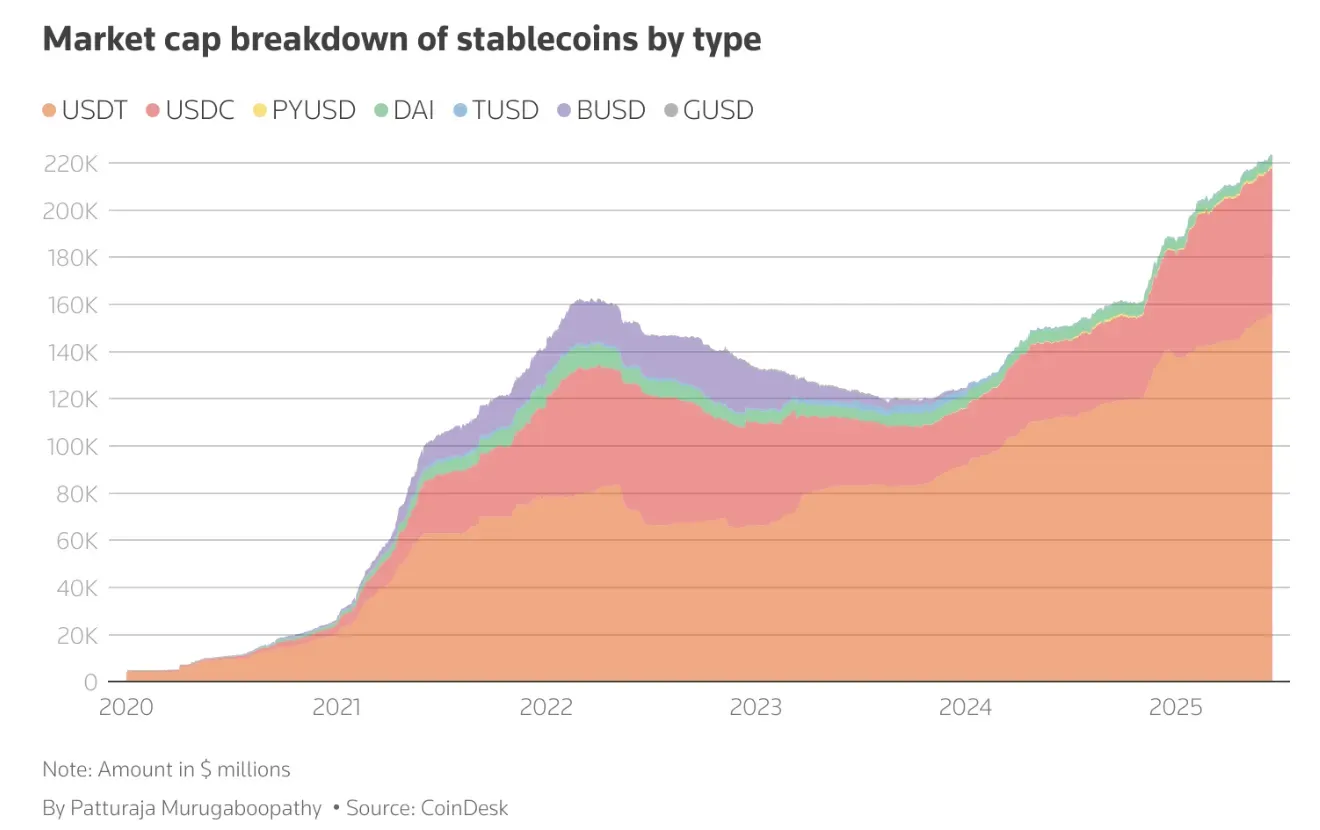
Goldman Sachs even dubbed 2025 the “Summer of Stablecoins,” and the timing isn’t accidental. With the passage of the GENIUS Act, the first federal framework for payment stablecoins, the U.S. has effectively greenlit a new era of compliant digital dollars. Today, there are roughly $130B in circulation, led by Tether ($85B), USDC ($28B), and DAI ($5B). Analysts expect that compliant issuers like USDC could outpace the market, growing at 40% CAGR through 2027.
Get The Artemis Fund’s stories in your inbox.
Get The Artemis Fund’s stories in your inbox.
Sign up for our newsletter
From Crypto Curiosity to Financial Infrastructure
From Crypto Curiosity to Financial Infrastructure
Stablecoins were designed to do one thing well: maintain a stable value. Unlike Bitcoin’s volatility, stablecoins are pegged (most often to the U.S. dollar). There are three main flavors: fiat-backed (USDC, USDT), crypto-collateralized (DAI), and algorithmic (many of which collapsed after the Terra/LUNA crash in 2022). What began as a convenience for crypto traders has become infrastructure for a much bigger vision: programmable money, instant settlement, and borderless liquidity.
In the 1950s, credit cards were plastic rectangles that very few merchants accepted. By the 1980s, they were an everyday tool of commerce, and Visa and Mastercard had become global networks. Stablecoins today are in their “plastic rectangle” era: not yet universal, but powerful enough to hint at the financial infrastructure they may become.
Adoption Beyond Speculation
Adoption Beyond Speculation
In 2024, stablecoin transfer volumes exceeded $27.6T, surpassing both Visa and Mastercard combined. For now, most of this activity is still driven by trading and arbitrage. Bots account for nearly 70% of stablecoin transactions on networks like Solana and Base. But cracks are forming in the speculative dominance, and real-world use cases are gaining momentum:
- B2B payments are scaling rapidly, reaching $3B monthly.
- Cross-border settlement is being reimagined by startups like OpenFX and Noah, offering faster, cheaper international transfers.
Just as card networks scaled by embedding themselves into daily consumer behavior, stablecoins will gain staying power when they solve real friction: moving payroll across borders, settling invoices instantly, and powering everyday checkout.
The Regulatory Greenlight
The Regulatory Greenlight
For years, uncertainty was the biggest drag on stablecoin adoption. The GENIUS Act has changed that by setting clear rules of the road. Key provisions include:
- Only authorized issuers (banks or OCC-approved nonbanks) may issue stablecoins.
- Every token must be 100% backed by cash, Treasuries, or insured deposits.
- Issuers must publish monthly reserve disclosures and undergo annual audits once scale is reached.
- Stablecoins are explicitly not securities or commodities; they fall under banking regulation.
- In bankruptcy, holders have superpriority claims on reserves.
This clarity has unlocked a floodgate. Banks are piloting their own deposit tokens. PayPal launched PYUSD to capture consumer payments. Mastercard has partnered with Circle to embed USDC into its network. Stablecoins are no longer sitting on the fringe. They are being integrated into the rails of mainstream finance.
Where the Next Wave of Growth Will Come From
Where the Next Wave of Growth Will Come From
- Ethereum-based infrastructure powering programmable money.
- Traditional banks taking on custody and issuance roles.
- Payments networks embedding stablecoins at the consumer level.
- E-commerce platforms unlocking global, borderless merchant settlement.
- Regulatory overreach that stifles innovation.
- The possibility of a sudden de-pegging event.
- Concentration risk from a few dominant issuers.
- Inefficiencies in overcollateralized DeFi models.
The feature that makes stablecoins appealing (their tie to the U.S. dollar) also makes them systemically important. If $200B+ in digital dollars were suddenly redeemed, the ripple effects on Treasury markets and monetary policy would be felt worldwide.
Stablecoins are no longer a crypto experiment. They are becoming the connective tissue between traditional finance and the next wave of digital infrastructure. With regulatory clarity, institutional adoption, and consumer use cases accelerating, the question isn’t if stablecoins will scale, it’s how and who will lead.
At Artemis, we’re closely watching founders who are building the rails: compliance infrastructure, sector-specific payment applications, and tools that ensure stablecoins drive economic mobility. Just as Visa and Mastercard became indispensable in the era of plastic, compliant stablecoins could become the operating system for money in the digital era.
The winners won’t just be fast. They’ll be trusted, transparent, and regulated. If you’re building at the intersection of fintech and programmable money, we’d love to hear from you.
We believe once in a generation companies will be built by unexpected founders. If that sounds like you, pitch us here!

Newsletter Signup
