

The New Consumer Health Stack
December 16, 2025

By The Artemis Fund
The Artemis Fund believes technology can create prosperity for all. With offices in New York, Texas, Massachusetts, and Nevada, Artemis leads seed rounds for companies creating resilient families, individuals, and businesses across the U.S.
In part one of this series, we covered how consumer led health can fix a broken system. In part two, we’re covering the emergence of a new health stack, composed of everyday tools, financial rails, and fast moving technologies that give individuals more agency than the traditional system has ever offered.
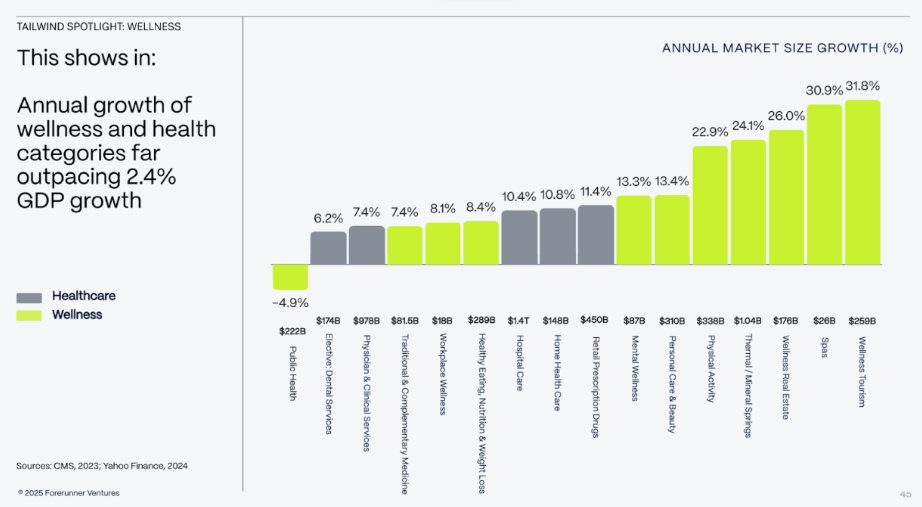
One of the strongest signals of this shift is what consumers are willing to pay for on their own. Wellness spending has expanded across nearly every category, from nutrition and sleep optimization to at home diagnostics. Growth rates far exceed GDP. As consumers acknowledge distrust in traditional health guidance, they are eager for clear, personalized information they can act on immediately. The success of biomarker driven services underscores this. People want to understand their own biology, and they are no longer willing to wait years for clinical pathways to catch up.
Get The Artemis Fund’s stories in your inbox.
Get The Artemis Fund’s stories in your inbox.
Sign up for our newsletter
Wearables as Continuous Monitoring Systems
Wearables as Continuous Monitoring Systems
Wearables sit at the center of this ecosystem. Wearables (including smartwatches, rings, adhesive patches, and smart apparel) provide continuous monitoring. They generate data that feels both intimate and actionable, tracking everything from heart rhythms and sleep cycles to glucose levels and stress signatures. Large companies like Apple and Google dominate the mass market, but high growth startups have carved out meaningful niches. Oura and WHOOP have redefined recovery tracking. With a tech layer and data insights, glucose monitoring has become a near frictionless experience for anyone curious about glucose, no script needed. New form factors and analytics expand what can be measured and for whom.
Trust and data privacy will be as important as ever. Newer wearables capture data that looks less like fitness and more like a medical record. When consumers believe the data is being used to support their health, they are willing participants. When they believe it may be shared with institutions or employers, they push back quickly. For example, the blowback received by Oura when they partnered with Palantir, or Meta's violation of privacy laws by allegedly collecting data from period tracking app Flo. This sensitivity will shape how the category scales. Companies that do not treat biometric data with clinical level safeguards will likely suffer some battlewounds.
HSA and FSA as New Consumer Health Capital
HSA and FSA as New Consumer Health Capital
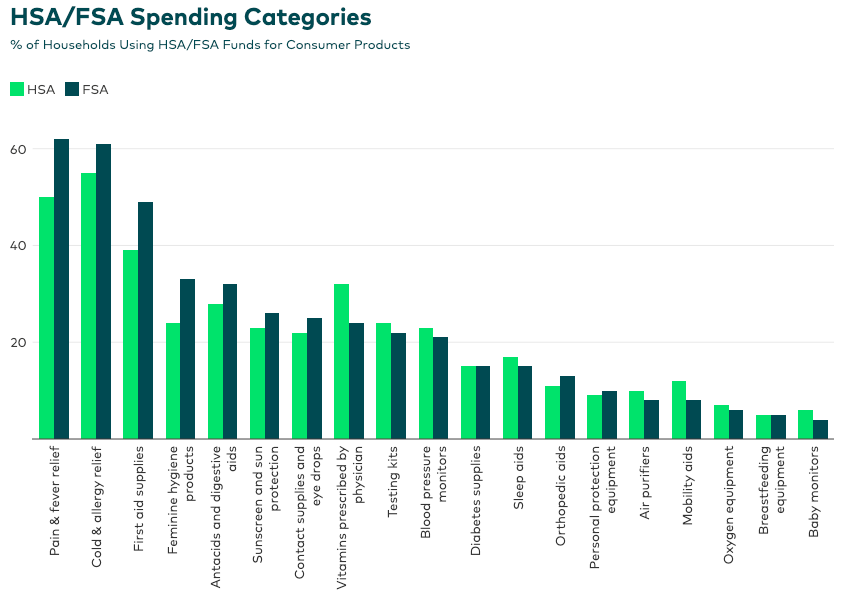
HSA and FSA accounts underscore another important shift. These financial vehicles have become one of the strongest signals of where consumer health spending is flowing. Today, 37% of Americans use an HSA or FSA, representing more than $100B in annual spend. While most wellness devices do not qualify automatically, consumers increasingly seek ways to use these funds for preventative or data driven tools. Companies like TrueMed are popping up to fill this demand and help wellness companies access customer wallets. Younger adults treat their accounts like wellness budgets, while families use them to access mental health support, fertility services, and alternative therapies. As eligibility expands and becomes easier to validate, these accounts could unlock a new wave of demand.
The majority of these efforts fall within “preventative health,” providing resources to help people understand and fine tune their health. While it is well established that eliminating poor diet, inactivity, and smoking would prevent the vast majority of heart disease, stroke, type 2 diabetes, and a significant number of cancers, only a fraction of adults achieve recommended exercise or nutrition levels. Consumer tools can support behavior change, but they cannot replace access to safe environments, affordable food, or stable income. The next generation of innovation must bridge this divide. Otherwise, optimization becomes a luxury product and prevention remains out of reach for many.
Big Tech’s Expanding Footprint
Big Tech’s Expanding Footprint
Apple, Amazon, Alphabet, and Microsoft are embedding AI across diagnostics, imaging, remote monitoring, and drug discovery. Their scale accelerates adoption and raises the bar for performance. It also increases the risk of commoditization. If multiple players offer similar capabilities, price pressure rises and differentiation becomes harder. Startups entering this arena will need more than elegant design. They will need clinical evidence, seamless integration, and a clear ROI for providers. The opportunity is enormous, but the bar to win is high.
Questions That Will Define the Next Decade
Questions That Will Define the Next Decade
These are the big questions we're thinking about at Artemis:
- Can AI meaningfully expand access rather than deepen inequity?
- Can consumer diagnostics evolve into bridges that connect people to care, rather than exist as parallel systems?
- Will metabolic drugs reshape long term behavior?
- Will the next wave of innovation reduce the burden on individuals or simply shift it into new products?
The consumerization of health has already rewritten the relationship between people and the healthcare system. The next phase is about building the platforms, protections, and clinical infrastructure that make this new model sustainable. For founders, this is a generational opportunity. It is a chance to create systems that are more accessible, more human, and more aligned with the way people live their daily lives.
We believe once in a generation companies will be built by unexpected founders. If that sounds like you, pitch us here!

Newsletter Signup
