

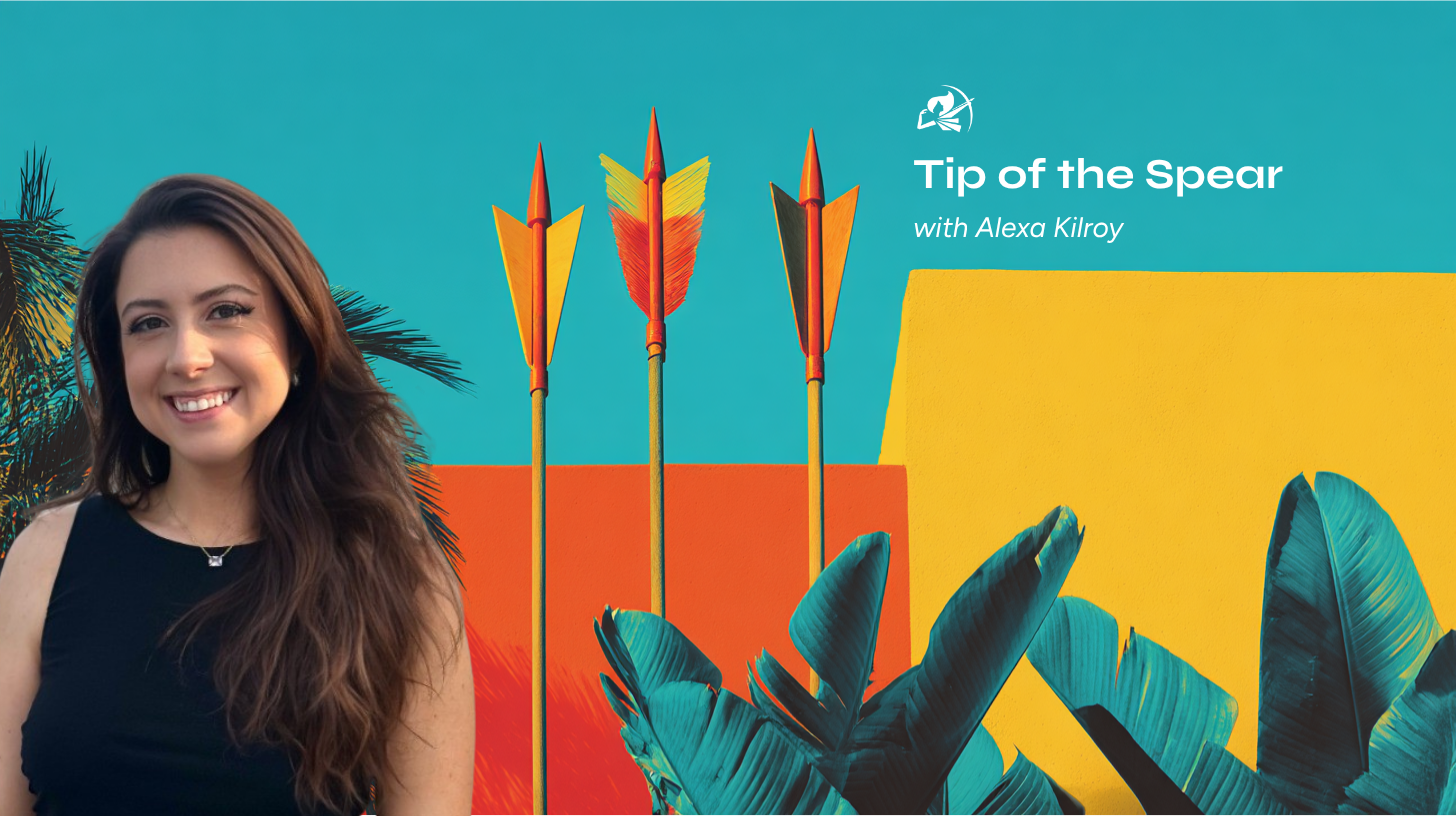
Tip of the Spear: Alexa Kilroy, Head of Marketing at Brij
March 24, 2026
By The Artemis Fund
The Artemis Fund believes technology can create prosperity for all. With offices in New York, Texas, Massachusetts, and Nevada, Artemis leads seed rounds for companies creating resilient families, individuals, and businesses across the US.
Tip of the Spear is an interview series highlighting The Artemis Fund’s expert network. Alexa Kilroy is Head of Marketing at Brij, with previous experience at FERMÀT, Triple Whale, and First Day.
Get The Artemis Fund’s stories in your inbox.
Get The Artemis Fund’s stories in your inbox.
Sign up for our newsletter
Q: You started your career as a high school English teacher. Can you talk a little bit more about that? What it taught you and what you carried with you throughout your career?
A: I always joke that the teacher-to-marketer pipeline makes so much sense because teaching is a combination of acting, caring a lot, and marketing in different ways.
You have a classroom full of 30 kids at any given time, and they’re thinking about what their crush is doing, what the kid next to them smells like, whether they did their hair well enough that day, if their mom is mad at them, the list goes on. Your whole job is to get them excited about things they would usually not be excited about.
Think about Shakespeare or grammar. It’s like selling sand in the desert. If you can successfully get kids excited about that kind of material, you’re pretty good at making compelling points. You learn how to speak to pain points and to things people actually care about.
That translates incredibly well to advertising, marketing, and copywriting. Teachers are also insanely creative because just talking at kids is ineffective. You have to come up with stories, experiences, and other unique ways to get them engaged. You have to be quick on your toes. All of that translates directly into being a persuasive marketer or brand marketer.
Q: How did you transition from teaching into growth marketing and commerce?
A: I moved to Austin right out of college. I double majored at Boston College in English and Secondary Education, and I tacked on a business minor. Once I finished school, I was ready to escape the cold. I landed on Austin as my city of choice.
I got a job teaching in Austin, but I was 21. I didn’t have any local friends yet, and teachers work constantly. You teach all day, grade and plan at night, and coach or chaperone on weekends. It was unsustainable. Bills were expensive, I lacked community, and I could tell that I wasn’t my best self.
I planned to pivot into another industry temporarily, so I could save money and build my life in Austin. I set myself as open to work on LinkedIn and did a six-month stint at an ed-tech company doing post-sales account management. It wasn’t a great fit. I was bored. I set myself as open to work again and got a call from a recruiter that was building the founding team at a growing e-commerce supplement brand in Austin.
She was describing the role and I thought, “I have zero qualifications for this.” But then she mentioned they were opening an Equinox in Austin and early employees would get a free membership. At the time, I could barely afford my $10 Planet Fitness membership. So I was like, “Okay, I’ll do the interview.”
I ended up getting really excited about the opportunity and took the gig. I had dabbled in photography and design throughout my life, so I started making product and ad creative for the brand. The founders saw I was able to pick things up fast, and they taught me how to run Facebook ads, too. Over time, I became really good at growth marketing and running advertising for an e-commerce brand.
That led to five years ago, when I got recruited to join an e-commerce SaaS platform (Triple Whale). I’ve been on the SaaS side since.
Q: What trends are you seeing in commerce and brand right now in terms of structural shifts?
A: I spent most of my career in DTC e-commerce, so I understood that world deeply. Now I’m at Brij and learning much more about complete, omnichannel consumer journeys.
To start, consumers shop wherever is most convenient for them. The journey is now more omnichannel than ever. For example, you might see a billboard, a bus ad, social ads, and then browse a brand’s website before buying in-store at Target.
From a brand perspective, it’s difficult to make business decisions when you lack all of that context into your buyers’ behavior. You only fully own the customer relationship when transactions happen on your site, and you lack visibility into all of those marketing touchpoints that influenced their purchase decision.
Retailers and platforms like TikTok Shop put space between brands and consumers to own the relationship, which makes things even harder for brands and worse for consumers who want cohesive brand experiences.
Consumers are also browsing and shopping via LLMs and TikTok search. That changes how the consideration phase works. Brands now need to think about AI-powered discovery the way we’ve long about SEO.
LLMs weigh Reddit and Quora heavily because they know that consumers want in-group, honest product reviews. Consumers have been searching for things like this for years, with queries like “best face wash Reddit.” The shift in search behavior is pushing brands to think strategically about community-driven content, so they can benefit from consumers talking about their products authentically online.
Personalization is now expected. It used to be a nice-to-have; now it’s table stakes. Consumers expect relevant ads, relevant brand experiences, and personalization at every touchpoint, not just in email and SMS.
Historically, marketing orgs separated brand marketing from performance marketing. At times, brand marketing was even seen as expendable. Now brand marketers are growth drivers, owning content, community, and creators. They’re closer to performance than ever before.
Q: What are your thoughts on traditional influencers?
A: Influencer marketing isn’t dead. It just looks different. Consumers want to see products actually being used in the content they’re consuming.
TikTok made the average non-marketer very aware of affiliate marketing. Now consumers look into the influencer behind the product placement, and try to assess how much product they’re pushing. If an influencer takes fewer brand deals, their endorsements are more powerful. Low-velocity creators who are selective feel more authentic and trusted.
Q: Based on Brij’s proprietary consumer engagement data, where do you see e-commerce marketing going?
A: Brij has two data layers: consumer data (how people engage with a brands’ rebates, sweepstakes, product warranties, and more) and brand-layer data (how consumers move through funnels and how brands test consumer touchpoints).
Brands want authentic consumer data more than ever; they’re getting sick of synthetic data. They want to know: What else did Jane buy when she bought my shampoo at Target? Did she also buy a conditioner from a competitor? What was the price point of other items on her receipt? Geography? Behavior across retailers?
For decades, marketing was dictated by broad stereotypes: think pink razors, pink pens, even pink gardening gloves for women. As the internet, ecommerce, and digital marketing evolved, teams gained access to more granular data. That made them hungry for even more.
The challenge is, too much data can cause teams to get lost in the weeds, crushing efficiency. But if you’re able to synthesize that data into truly meaningful insights, your marketing becomes far more efficient.
The leading brands in ecommerce are capturing as much buyer data as possible, leveraging AI tools to glean insights, and then applying their creativity to those insights to deliver masterful marketing campaigns. It’s not about data or creative. It’s both.
These brands have rich customer persona profiles, behavioral-based marketing triggers, and automated personalization that makes customers feel like they have an actual relationship with the brand.
Q: What’s something about omnichannel that people aren’t fully seeing yet?
A: Brands risk tripping up by becoming too channel- or function-focused. Siloing marketers disconnects the customer journey. Consumers experience brands everywhere, so marketing teams need to be extremely collaborative and operationally aligned to deliver cohesive experiences.
Q: You’ve joined companies at major inflection points. What patterns have you seen in what makes teams successful?
A: The hardest thing for founders is listening. Founders fail when they push their desired product narratives instead of meeting the market where it is.
Listening to customers and frontline teams is a non-negotiable. The voice of customer is gold, and leaders often get too far removed from it.
Brij is a great example. We know that the average business leader isn’t searching for “AI-powered omnichannel marketing platform.” They’re searching to solve a problem or find a tool to help them with a goal, which means they’re likely searching something product-specific like “digital rebates” or “sweepstakes platform”. Our job is to meet them there, then expand the narrative to tell the full story of Brij.
Hiring is the other big thing. If you’re not good at hiring, you need to find someone who is. Hire great people, trust them, and let them run. Build your Avengers team and give them the autonomy they need in order to make meaningful impact.
Q: What is critical at the early-stage to establish foundational marketing?
A: First is CRM cleanup. Know who your customers, leads, MQLs, SQLs are. Second is basic analytics: web traffic, SEO, site behavior. Third: paid ad account setup. Google and Meta verification can stall momentum if not handled early. Fourth (and this is my secret) hire a sharp junior generalist marketer early. Someone who can execute fast while you handle strategy. You can’t do both forever.
Q: How does a company move beyond founder-led marketing?
A: You need to show the world that other smart people work there, too. I recommend leveraging PR, employee social content, and sending people to events. You also need to operationalize what made your founder-led marketing work. Extract the founder’s thought leadership and embed it across the brand.
Finally, use data to build trust through reports, benchmarks, insights. Data signals credibility.
Q: What’s a trend or company you’re excited about?
A: B2B marketing is fun again. Ramp is a great example. Their Times Square activation with Kevin from The Office processing receipts manually told a story. Creative B2B doesn’t reduce credibility. It garners the attention necessary to truly stand out amongst the competition.
Q: What’s the best career advice you’ve gotten?
A: When I was a teenager, my mom told me that the things that made me “weird” at the time would prove to be the things that made me successful later. She was right. Be fearlessly authentic. It helps you find the right people and organizations.
Also, make your wins as loud as your losses. Leaders hear about problems constantly. Celebrate your team’s wins, share them proudly, and advocate for them.
We believe once in a generation companies will be built by unexpected founders. If that sounds like you, pitch us here!

Newsletter Signup
