

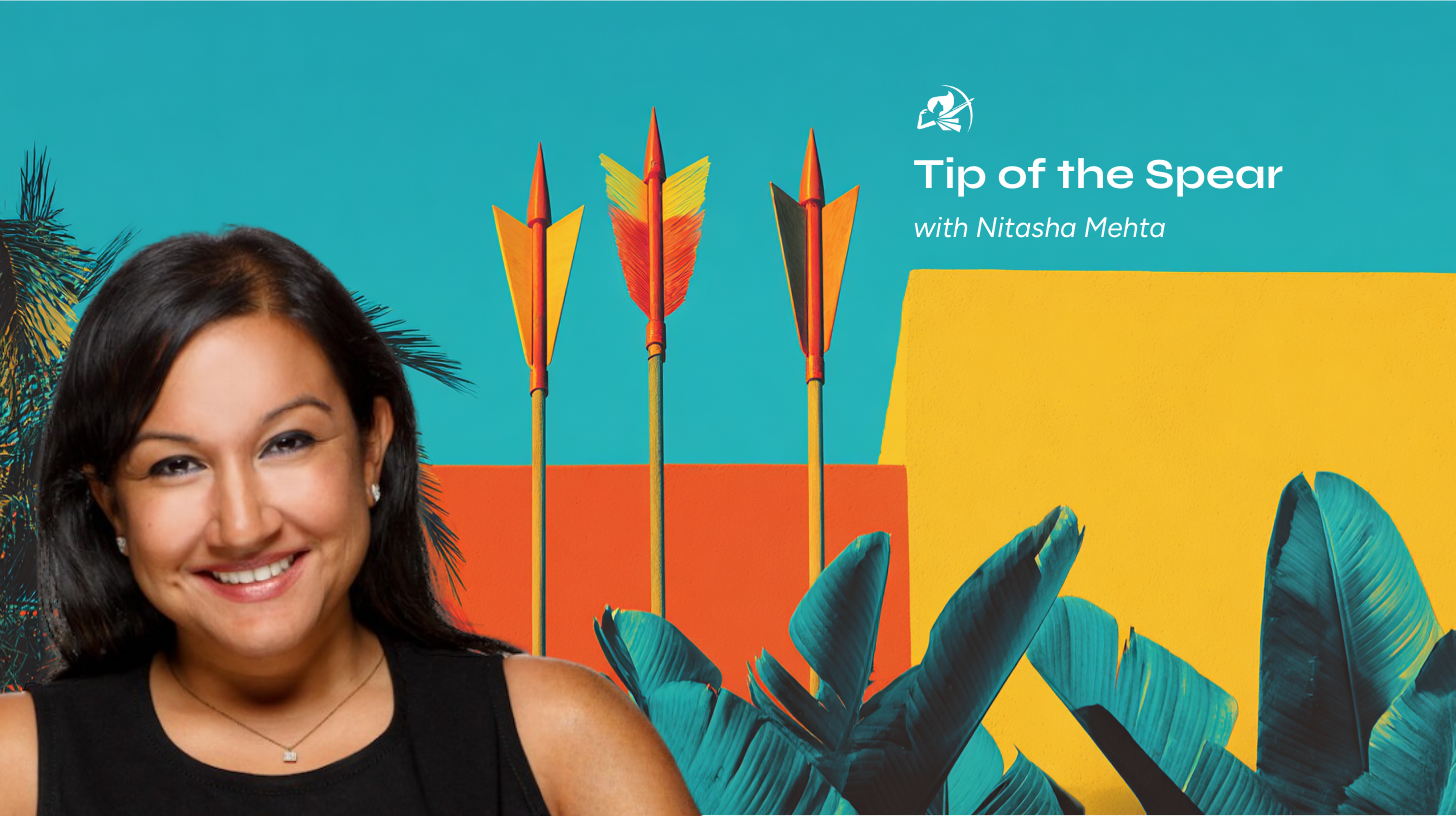
Tip of the Spear: Nitasha Mehta, Everygene CMO, former Amazon & Boxed
March 16, 2026
By The Artemis Fund
The Artemis Fund believes technology can create prosperity for all. With offices in New York, Texas, Massachusetts, and Nevada, Artemis leads seed rounds for companies creating resilient families, individuals, and businesses across the US.
Tip of the Spear is an interview series highlighting The Artemis Fund’s expert network. Nitasha Mehta is Chief Marketing Officer at Everygene, with previous experience at Amazon Samsung, and Boxed.
Get The Artemis Fund’s stories in your inbox.
Get The Artemis Fund’s stories in your inbox.
Sign up for our newsletter
Q: Can you tell me about your first job and what it taught you about growth and scale?
A: My first job right out of undergrad was at a search engine marketing startup called Reprise Media. We were a 10-person shop with clients like Guess and Bluefly. We worked across all the major search engine marketing tools at the time, like Google, Yahoo, Miva, and Ask Jeeves.
We were one of the only organizations hyper-specialized in search marketing back then. A couple of years after I left, the company was acquired by IPG.
What I learned was the power of specialization. By focusing deeply on a specific capability (search) and perfecting it, we delivered real results and built a defensible position. That ultimately enabled scale and acquisition. It was an incredible first job. I learned an enormous amount, and it’s one of the reasons I later returned to startups. The experience of being in a small, fast-moving environment is incomparable.
Q: What initially pulled you into ecommerce and brand partnerships? When did you realize how valuable partnerships could be as a growth lever?
A: I joined Amazon after getting my MBA, and that’s when I became obsessed with ecommerce and direct-to-consumer. I was doing content marketing for mobile electronics, specifically GPS navigation devices and MP3 players.
During that time, I was part of the team that onboarded Nike onto Amazon’s platform for the first time. There were significant trust concerns on Nike’s side, because this was still early in Amazon’s evolution. I worked closely with TomTom, one of my vendors. TomTom had developed a GPS sport watch in partnership with Nike. Through that product collaboration, we were able to onboard Nike onto Amazon for the first time.
I remember Jeff Bezos personally reaching out to our team to ask when the product was launching because Nike created so much awareness around it. It was a very high-visibility launch. It was exciting and nerve-wracking, but that’s when I really understood the power of thoughtful, intentional partnerships.
Q: What do you think teams underestimate about brand partnerships?
A: Brand partnerships are one of the most underrated, cost-efficient ways to drive new user acquisition. When you develop thoughtful partnerships with brands aligned to your mission, you can cross-pollinate audiences and tap into entirely new segments.
It’s mutually beneficial, especially when values are aligned. Many organizations default to performance marketing first. But if you’re looking for high-intent, high-quality users, partnerships add credibility and trust while creating a new acquisition funnel. That’s often underestimated.
Q: How do you find the right partners?
A: Look for complementary brands. Shared values, aligned missions, advocates in the same space. The goal is mutual audience expansion. When you’re sharing resources, distribution, and marketing channels, the value exchange can be significant.
Q: Beyond Nike and TomTom, are there other partnerships you led that really worked well?
A: Yes. During my time at Boxed, I launched an initiative as a passion project that led us to become the first, and at that time only, U.S. retailer to take a stand on gender pricing inequities like the “pink tax” and tampon tax. We discounted items that cost more for women than their male counterparts, and period care products that were taxed in over 35 states at that time.
I started by analyzing manufacturer cost data and found significant discrepancies. Women’s razors, shave gels, and deodorants sometimes cost up to 112% more than the men’s versions. I brought a spreadsheet to our four male co-founders and showed them the differences. They were shocked.
Eighty percent of our customers were women, yet we were charging them more for essential items. That’s how I made the case. From there, we partnered with Girls Helping Girls, Period and Seventh Generation, donating tens of thousands of period care products to underserved communities.
On the business side, we partnered with Seventh Generation and Refinery29 to create an experiential activation at 29Rooms. We took over a bathroom installation with educational messaging about menstrual equity and period poverty. At the time, many women didn’t even know they were paying sales tax on these items.
We were able to track foot traffic to a dedicated landing page and measure conversions through re-engagement campaigns. It was a powerful three-part partnership that combined credibility, advocacy, and measurable revenue impact.
Ultimately, through these types of partnerships and by adjusting our offerings to ensure pricing equity, we were able to acquire tens of thousands of net-new customers to the platform.
Q: What do the most resilient founders you’ve worked with have in common?
A: They have a clear vision and can communicate it effectively and transparently. They align the organization around shared goals.
But they also have the humility to pivot if something isn’t working. That nimbleness, especially around product-market fit, is critical.
Q: What do you wish early-stage founders understood about partnerships driving revenue, not just visibility?
A: The true collaboration matters. It’s not about collecting logos for your website. The right partnership, where both parties lean in and leverage their resources, can significantly increase trust, credibility, and revenue. But it has to be thoughtful and mutually beneficial.
Q: Before a startup has clear product-market fit or a big budget, what should founders focus on?
A: Focus less on scale and more on learning and trust-building. Talk to your customers. Pressure-test your value proposition, distribution channels, and product assumptions.
That first-party insight is invaluable. While early performance marketing data is useful for signaling what messages and audiences gain traction, it can’t replace a deep, foundational understanding of your customer. And the right partnerships can help build credibility early on.
Q: Is there a trend or company you’re especially excited about right now?
A: I’m really excited about AI in healthcare, specifically solving EMR and EHR challenges and democratizing those systems. The opportunity to responsibly leverage data for truly personalized treatment plans is enormous. The ethical considerations are critical, but the potential impact is massive.
Q: What’s the best piece of career advice you’ve received?
A: Surround yourself with people who know more than you. That’s the only way to ensure continuous personal and professional growth.
In every role, I try to either dig into a new topic or work with people who have deep expertise. That’s where I feel most energized. I started in search engine marketing and electronics at Amazon and Samsung. My passion project around menstrual equity at Boxed ignited my interest in healthcare and women’s health. That changed the trajectory of my career.
Being open to where your path leads you is so important. You never know what will truly energize you.
We believe once in a generation companies will be built by unexpected founders. If that sounds like you, pitch us here!

Newsletter Signup
