
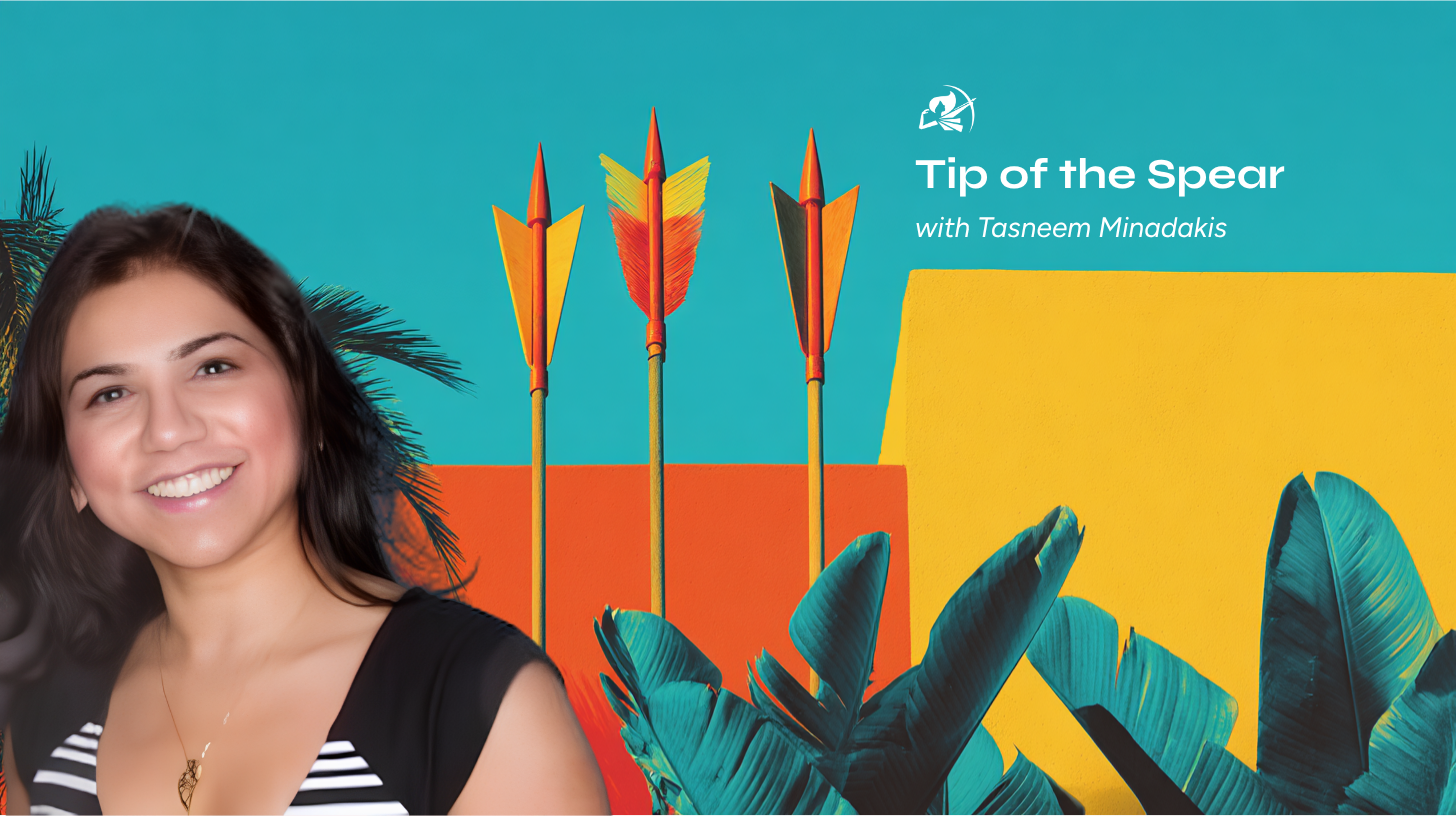
Tip of the Spear: Tasneem Minadakis, Director of Engineering at YouTube
August 7, 2026
By The Artemis Fund
The Artemis Fund believes technology can create prosperity for all. With offices in New York, Texas, Massachusetts, and Nevada, Artemis leads seed rounds for companies creating resilient families, individuals, and businesses across the US.
Tip of the Spear is an interview series highlighting The Artemis Fund’s expert network. Tasneem Minadakis is a Director of Engineering at YouTube and early-stage startup advisor.
Get The Artemis Fund’s stories in your inbox.
Get The Artemis Fund’s stories in your inbox.
Sign up for our newsletter
Q: Talk to me about your first job and what you learned from it.
A: I moved to the US for grad school. My first job was at the school cafeteria. It turns out that I misestimated my school semester fees and used all my funds for tuition, and I had no money for my first month's rent.
My first assignment on the job was to stock the freezers. This was not a fun or pleasant job, but the job offered a meal coupon that was enough to cover most of my meals! I wasn’t complaining. After some time, I started to get along with the manager. I realized that she struggled to keep her inventory and marketing material organized, as she wasn’t computer savvy. I told her that I was good with computers and would be happy to help. I ended up working myself out of the stocking job into being her computer person, organizing all her inventory, finances, and marketing.
I was in a moment of crisis and really needed the job. But that led to this learning: if you can show up with integrity and do good work, support your colleagues and your boss, then there will be people willing to sponsor you for the next opportunity. Also, I learned to seek opportunities even when they are not directly presented to you.
Q: Talk to me about an early moment in your career where something broke and it fundamentally changed how you think about building systems and scaling.
A: I graduated in 2002, during the dot-com bust, one of the saddest years to graduate from college. I hadn’t found a full time job yet. Again in a moment of desperation, I called a recruiter who'd previously offered me an internship at a company called JD Edwards. I had chosen to decline the internship the previous summer. I told her how much I enjoyed speaking with the team during the interview process and would love an opportunity to work for the company.
She must have sensed my conviction and desperation and put me in touch with a hiring manager who was looking for a college graduate for his team. I spoke to the Senior Tech Lead and the Director over one phone call, and they hired me. I was one of the fortunate few in college who graduated with a job in hand.
Persistence is an important ingredient in the recipe for success. It is better to take the chance and be told no than not take it at all. And at times you just have to find the detours around the roadblocks in your way. These learning moments have played out across many stages in my career.
When I worked on Surface, I was curious enough to realize that there was a strategic pivot where the software product was going to become native as part of the Windows Operating System. At Uber, when the company was undergoing a PR crisis, most women declined the opportunity to work with the company. We decided to host a women’s tech summit showcasing the impressive work across the company. This served as the most successful recruiting event for women at the company during that time. At YouTube Shopping, our executive initially declined our business proposal. But we were convicted enough on our approach that we bootstrapped the pilot in parallel to getting leadership alignment.
Over the years, I have built strong partnerships because I show up with persistence and curiosity, a desire to do what’s best for the customer even if it may seem hard at first.
Q: You've worked across search, marketplaces, advertising platforms, and creator commerce. What structural shifts are you seeing in digital commerce or creator-driven marketplaces?
A: There have been a few major shifts in my career. Mobile in 2007, the shift to cloud, social around 2010, AI/robotics automation around 2023 accelerating into generative AI. Creator commerce has been around since 2010 in the form of affiliate marketing on social platforms and blogs. Around 2016, it shifted toward live streaming and video commerce, especially in China and Southeast Asia with the launch of Douyin and others. It's been an interesting mechanism where inspiration, research, consideration, and the buy loop all happen within a video e-commerce platform, whether that's TikTok Shop, Douyin, or YouTube Shopping.
Now with generative AI, there's another shift coming. OpenAI and Google are both trying to extend the consideration and research journey towards an agentic commerce experience. The intention is that you can ask an agent "find me the best leather jacket for fall in Boston" and the agent handles the research and purchase.
What's interesting is the shift from merchants using creators as a voice to market products, to that voice being curated and consumed through generative AI. The open question is how attribution evolves. Will creators become a commodity with AI generated content or will we find a better way to attribute content to the original creator of the content?
Q: What do people still most underestimate about the future of creator-led shopping ecosystems?
A: My thesis is that creators are here to stay even in the era of AI generated content creation. Humans are social beings. We're inspired when someone we trust, a friend or an influencer, says they use and love a product. I believe that the medium of engagement may evolve but the human connection will sustain. The consumptive nature of content keeps evolving from blog posts to instagram feeds to videos and livestreams.
If an agent evolves to making choices on my behalf, I’d want to know what the agent consumed and learned from the content to make the recommendations being made. I’d want to validate if our choices stay aligned. There are lots of interesting questions on how we evolve content creation and consumption for agentic workflows.
Q: What is one trait you see consistently in the most resilient founders or teams?
A: Three things come together in the high-performing teams and founders I've respected: grit, adaptability, and humility. Grit is the persistence to keep at the thing that you are passionate about. Adaptability is recognizing when you need to change course, and recognizing it before it becomes a real problem. And humility, leaving your ego at the door, because you're building with a team and it's not about you, it's about the team. When those three things come together, they create real magic in terms of how productive a team can be.
Q: What do great technical leaders do differently when building their teams in early-stage companies?
A: First, hiring the right people who have the mindset to challenge the status quo, put the user first, and stay comfortable with change. Then giving that team the structure and focus they need to do their best work. In the early days, when there's a ton of ambiguity, you have to create an environment where people solve smaller problems iteratively instead of trying to tackle huge problems that take months to figure out. Speed of iteration and getting to market fast matters enormously, especially now, when it's easy to build an app through vibe coding in a week. You need a clear strategic focus that extends two or three years out, but also the discipline to say, "in the next month, let's solve this one metric." If user growth is what matters, find ways to simplify the funnel and improve the experience. Clear focus with a time-bound goal is what lets a team iterate their way toward that goal.
Q: When a product starts scaling faster than expected, what are the warning signs?
A: One clear gauge: how much of your bandwidth is going to fixing issues and dealing with outages. If that starts exceeding around 10%, if you're spending a big chunk of your time on operational problems, bugs, customer complaints, outages, rising latencies, background jobs taking too long, you need to step back and ask why.
In many cases it comes down to underinvestment in technical infrastructure. But then the question is: why did that underinvestment happen? Were there cultural or systemic issues preventing the team from making good calls about when to invest in technical foundation versus scaling quickly? Scaling quickly is never not going to be a requirement, but the risk is that teams put off the "why" for too long until it becomes a bottleneck, and then they're not growing quickly anymore because they're stuck fixing the foundation.
There's no silver bullet, no fixed amount of bandwidth you should spend on technical foundation at any given stage. But you have to be willing to catch the moments where you have enough product-market fit that you need to step back and evolve your technical foundation, while staying scrappy in the areas where you don't yet have product-market fit or clarity on what you're building. It's a constant check-in with yourself on whether you're investing in a way that holds up over time.
Q: Is there a founder or company you're excited about right now?
A: The one trend I'm actually really curious about is how we evolve the way we teach kids in a world of AI. How will our education systems and learning software adapt? We missed the impact of social media on kids, we caught it way too late. The question on my mind is what this means for the next generation and how we make sure technology helps them thrive instead of hurting them. I have a five-year-old son, and critical thinking is one of the most important things you can teach a kid, but it's hard to teach. Will AI short-circuit that, will these learning mechanisms take away the critical thinking muscle in kids? That worries me deeply, and I'm curious to see how learning software evolves to actually help kids learn better.
Q: What’s the best career advice you've ever gotten?
A: Years ago someone told me that what you may be good at is not always what makes you happy. Balancing what makes you happy day to day or week to week is how you manage burnout. If your scale tips too far toward doing things that don't make you happy, that doesn't bode well for whether you want to stay in the job or at the company. You're not going to have that balance every single day, there are always trade-offs on any given day or week between things at work, or between work and life. But in aggregate, if I look back at my year or my quarter, I want to be able to say I invested my energy in the five things I actually enjoy doing. If I spent, say, 60% of my portfolio on things I enjoy, I still enjoy coming into work every day. That's something I try to live by. And if I can't find that, or can't create the space for it, that's a good warning sign that I need to figure out what's next.
We believe once in a generation companies will be built by unexpected founders. If that sounds like you, pitch us here!

Newsletter Signup
