

Why Commerce Tech is Due for a Reset
July 1, 2025

By Juliette Richert
The Artemis Fund believes technology can create prosperity for all. With offices in New York, Texas, Massachusetts, and Nevada, Artemis leads seed rounds for companies creating resilient families, individuals, and businesses across the US.
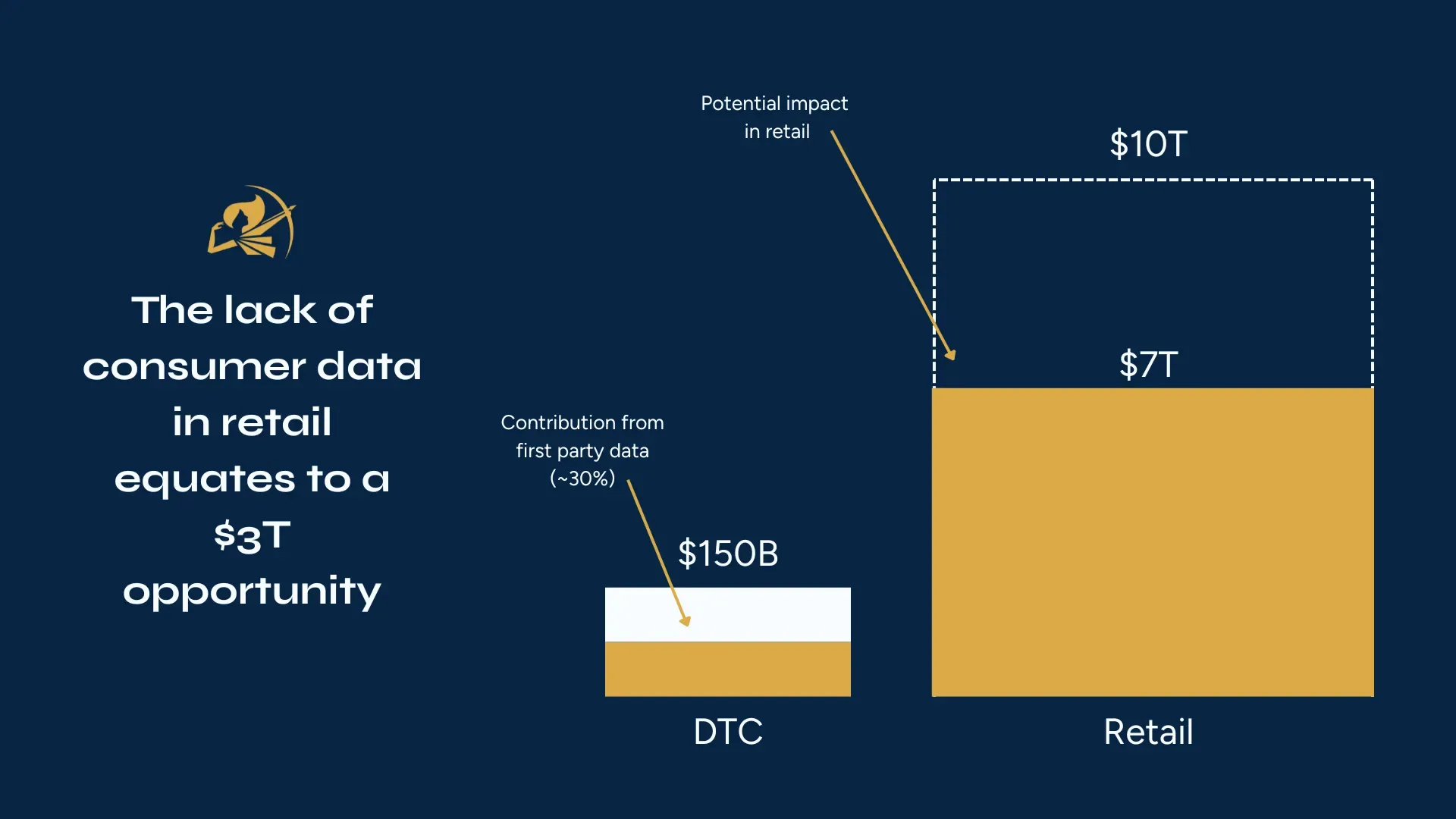
The retail landscape is massive and fragmented. In the U.S. alone, retail spending totals over $7.2T annually. Only about $1T of that flows through ecommerce channels including brand-owned sites or online retailers like Amazon. Within that slice, DTC commerce makes up less than 3% of total spend. That’s a few cents on every retail dollar.
Over $6T worth of products are sold each year through wholesalers and retailers, including Walmart, Target, and local mom-and-pop shops. But for brands, retail is a black box. When someone buys a toothbrush at Walmart, the toothbrush brand has no visibility into who the customer is, why they chose the product, or how to engage with them afterward.
Get The Artemis Fund’s stories in your inbox.
Get The Artemis Fund’s stories in your inbox.
Sign up for our newsletter
The lack of transparency makes retail a mystery: brands may know how many units sold, but not who purchased them or what motivated the sale. As a result, marketers are left relying on outdated tools like TV, print, or broad digital ads with little clarity on which campaigns are actually working. In other words, “Half my advertising is wasted. I just don’t know which half.”
When brands sell direct-to-consumer (DTC), they know who the customer is, what else is in their cart, and if they’re a repeat customer. Omnichannel attribution is much more difficult because of the lack of meaningful data from retail customers. That gap represents a massive opportunity to build better infrastructure, bringing transparency to brands, and even richer data to the retailers themselves.
The Martech Surge
The Martech Surge
Even with tighter budgets, marketing remains essential to any brand’s customer acquisition strategy. And if a marketing tool can be tied directly to revenue creation, all the better. Marketers are spending to solve a real need, but too many disjointed tools create a different type of headache. On average, brands rely on 7–10 tools just for personalization alone, introducing fragmentation and inefficiency.
Without the right infrastructure, brands face operational challenges like managing cumbersome sweepstakes or rebate campaigns that require legal reviews and manual updates, and stitching together fragmented customer journeys across multiple systems. It’s no wonder many teams attempt to build solutions in-house, only to find the process expensive, slow, and difficult to maintain.
Top Down Market Size
Top Down Market Size
Looking at top down market size estimates, we see significant opportunity.
- $148B global spend on MarTech in 2024, expected to hit $215B by 2027 (13.3% CAGR).
- In 2023, US MarTech spend reached $20B+. We believe this number will grow as AI and tech developments increase efficiencies and expectations.
Bottom Up Market Size
Bottom Up Market Size
How much a company spends on marketing can be affected by, well, the market. When times are good and focused on growth, marketing budgets make up 9–10% of a company’s total revenue. In 2024, we saw a 7.7% allocation on average to marketing. This is reflective of total marketing spend, including: ad creation, paid marketing, potential partnerships, etc.
Of this budget, Martech makes up ~25% of spend. With these insights, we can make some assumptions and estimate an optimistic market size.
Other Market Validation
Other Market Validation
For further proof of market opportunity, we can look to Klaviyo, a CRM and personalized engagement tool for ecommerce (DTC) brands combining email marketing and SMS.
As of the end of 2024, Klaviyo reported $937.5M in annual revenue across more than 167K customers (resulting in an approximate ACV of $5,600). While Klaviyo’s scale is impressive, the vast majority of its revenue comes from smaller brands: over 140,000 of its customers generate less than $50K annually. According to Klayvio, only 2,386 customers contribute more than $50Kin annual recurring revenue, a cohort that has grown 64% YoY, but still makes up just under 1.5% of its user base.
Klayvio is obviously a killer business, and remember what a small fraction DTC is of total retail? Less than 3% of U.S. retail sales!
A great business has been built without touching the revenue that comes from retail sales, the brands that only sell through retailers, or the customer that shops there. Klayvio proves that unified, first-party consumer data is one of the most effective tools for driving revenue and engagement. Now, there is a massive opportunity to serve the 97% of retail sales that occur in non-brand-owned channels.
First-Party Data Is the New Currency
First-Party Data Is the New Currency
Reaching customers online has gotten more expensive and more competitive. With new regulations, first party data is more than a nice to have, it’s necessary for survival in a privacy-first world:
- 20 U.S. states have passed data privacy laws as of September 2024.
- The EU’s DSA, Australia’s Privacy Amendment, and China’s PIPL are enforcing stricter consumer protections globally.
- The loss of third-party cookies combined with rising CAC has made first-party data non-negotiable.
In addition to privacy, first-party data makes money. In 2020, Google and BCG found that companies using first-party data saw 2.9x revenue uplift and 1.5x cost savings. Today, 61% of high-growth companies are building personalization strategies around first-party data.
However, for retail-heavy brands, getting that data is incredibly difficult, if not impossible.
What Comes Next
What Comes Next
The next wave of growth in commerce tech won’t come from flashy ad tools or incremental DTC optimization. It will come from the infrastructure layer: the connective tissue that gives brands real-time access to customer behavior, no matter where a transaction takes place. This is why we’re so excited about Brij, a recent addition to the Artemis portfolio. Brands that invest in tools built for signal over noise, scale over silos, and owned relationships over intermediated ones will be best positioned to capture and convert demand.
We believe once in a generation companies will be built by unexpected founders. If that sounds like you, pitch us here!

Newsletter Signup
